
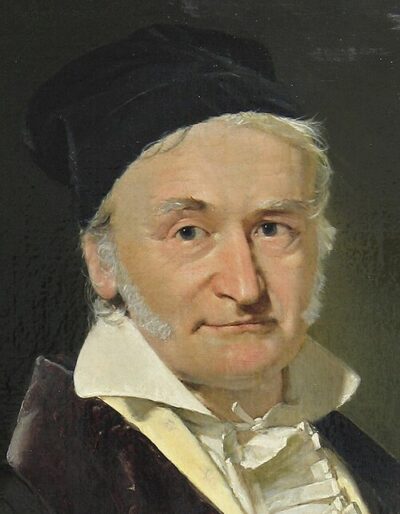
Carl Friedrich Gauss
Carl Friedrich Gauss was a German mathematician and physicist. Born April 30, 1777, in Brunswick. Died February 23, 1855, in Göttingen. Known for Gauss–Seidel method, Gauss's law and Gauss's law for magnetism. Educated at University of Helmstedt and University of Göttingen. Awards include Pour le Mérite for Sciences and Arts order, Fellow of the Royal Society and Copley Medal.
Facts
62 facts · 2 confirmed by two sources · 17 cited · 43 from one source
Where this comes from
Papalocal keeps its own record. It started from these sources; what each one said is kept here as it was copied, so a change on their side never changes this page by itself. Tap one to read its version.
What Wikidata says · copied November 16, 2026 · revision 2568291803
- Described as
- German mathematician and physicist (1777–1855)
- Other names
- Carl Friedrich Gauß, Karl Gauss, Johann Carl Friedrich Gauss, C. F. Gauss, Gauß, Carl Friedrich, Gauss
- Born
- April 30, 1777 · 10 references
- Died
- February 23, 1855 · 10 references
- Born in
- Brunswick · 5 references
- Died in
- Göttingen · 8 references
- Buried in
- Albanifriedhof · 1 reference
- Name at birth
- Johann Carl Friedrich Gauß · 1 reference
- Citizen of
- Confederation of the Rhine; Kingdom of Hanover · 2 references
- Occupation
- mathematician · 3 references; geophysicist; astronomer · 4 references; science writer; physicist · 2 references; surveyor; university teacher; statistician · 1 reference
- Worked for
- University of Göttingen
- Education
- University of Helmstedt (–1799); University of Göttingen (1795–1798); Collegium Carolinum (1792–1795) · 1 reference
- Member of
- Royal Society of London (1804–); Royal Swedish Academy of Sciences; Göttingen Academy of Sciences and Humanities in Lower Saxony; Saint Petersburg Academy of Sciences; Hungarian Academy of Sciences; American Academy of Arts and Sciences; Bavarian Academy of Sciences and Humanities; Russian Academy of Sciences; Royal Prussian Academy of Sciences; Royal Netherlands Academy of Arts and Sciences
- Known for
- Gauss–Seidel method; Gauss's law; Gauss's law for magnetism; Gauss's law for gravity; normal distribution; Disquisitiones Arithmeticae; Disquisitiones generales circa superficies curvas; Atlas des Erdmagnetismus: nach den Elementen der Theorie entworfen
- Awards
- Pour le Mérite for Sciences and Arts order (1842) · 1 reference; Fellow of the Royal Society (1804) · 1 reference; Copley Medal (1838) · 1 reference; Bavarian Maximilian Order for Science and Art (1853); Lalande Prize (1809); Fellow of the American Academy of Arts and Sciences (1822) · 1 reference; honorary member of the Physics Association (Frankfurt am Main, Germany) (1839)
- Field
- number theory; algebra; mathematical analysis; differential geometry; electrostatics; optics
- Spouse
- Friederica Wilhelmine Waldeck (1810–1831) · 1 reference; Johanna Osthoff (1805–1809) · 1 reference
- Children
- Eugene Gauss · 2 references; Joseph Gauß · 1 reference; Wilhelmine Gauss · 1 reference; Therese Gauss · 1 reference; Charles William Gauss · 1 reference
- Father
- Gebhard Dietrich Gauss · 1 reference
- Mother
- Dorthea Benze · 1 reference
- Lived in
- Kingdom of Hanover; Brunswick
- Wikipedias with a page
- 201
Wikidata item Q6722 (wikidata.org/wiki/Q6722), public domain (CC0). Copied November 16, 2026.
What Wikipedia says · copied November 16, 2026 · revision 1383007994
Johann Carl Friedrich Gauss ( ; German: Gauß; 30 April 1777 – 23 February 1855) was a German polymath active as a mathematician, astronomer, geodesist, and physicist, who contributed to many fields in mathematics and science. His mathematical contributions spanned the branches of number theory, algebra, analysis, geometry, statistics, and probability. Gauss was director of the Göttingen Observatory in Germany and professor of astronomy from 1807 until his death in 1855.
From an early age, Gauss was known as a child prodigy in mathematics. While studying at the University of Göttingen, he propounded several mathematical theorems. As an independent scholar, he wrote the masterpieces Disquisitiones Arithmeticae and Theoria motus corporum coelestium. Gauss produced the second and third complete proofs of the fundamental theorem of algebra. He also introduced the triple bar symbol (≡) for congruence. In number theory, he made numerous contributions, such as the composition law, the law of quadratic reciprocity, and proved the triangular case of the Fermat polygonal number theorem. He also contributed to the theory of binary and ternary quadratic forms, and the theory of hypergeometric series. When Gauss was only 19 years old, he proved the construction of the heptadecagon, the first progress in regular polygon construction in over 2000 years. He also introduced the concept of Gaussian curvature and proved its key properties, especially with his Theorema Egregium. Gauss was the first to prove Gauss's inequality. Further, he was instrumental in the development of the arithmetic–geometric mean. He introduced the normal or Gaussian distribution in probability. Due to Gauss's extensive and fundamental contributions to science and mathematics, more than 100 mathematical and scientific concepts are named after him.
Gauss was instrumental in the identification of Ceres as a dwarf planet. His work on the motion of planetoids disturbed by large planets led to the introduction of the Gaussian gravitational constant and the method of least squares, which he had discovered before Adrien-Marie Legendre published it. Gauss also introduced the algorithm known as recursive least squares. Gauss led the geodetic survey of the Kingdom of Hanover together with an arc measurement project from 1820 to 1844; Gauss was one of the founders of geophysics and formulated the fundamental principles of magnetism. He provided the first absolute measurement of Earth's magnetic field in 1832, later applying one of his inventions, that of spherical harmonic analysis, to show that most of Earth's magnetic field was internal. He was the first to discover and study non-Euclidean geometry, which he also named. Gauss was the first to develop a fast Fourier transform, doing so some 160 years before John Tukey and James Cooley. His practical work led to the invention of the heliotrope in 1821, a magnetometer in 1833 and – with Wilhelm Eduard Weber – the first electromagnetic telegraph in 1833.
Gauss was awarded the Lalande Prize in 1809 for his work on planetary theory and determination of orbits, and the Copley Medal in 1838 for his mathematical research in magnetism. He is known for not publishing incomplete work and left several works to be edited posthumously, as a result; this practice delayed the dissemination of many of his discoveries. He believed that the act of learning, not possession of knowledge, provided the greatest enjoyment. While Gauss was not a committed or enthusiastic teacher, generally preferring to focus on his own work, some of his students, such as Richard Dedekind and Bernhard Riemann, became well-known and influential mathematicians in their own right. He married twice and had six children, several of whom later emigrated to the United States.
- Born, in its opening lines
- April 30, 1777
- Died, in its opening lines
- February 23, 1855
From the Wikipedia article “Carl Friedrich Gauss” (en.wikipedia.org/wiki/Carl_Friedrich_Gauss), by its contributors, under CC BY-SA 4.0 (creativecommons.org/licenses/by-sa/4.0/). Copied November 16, 2026; not changed.
Confirmed Two sources agree. Cited One source, and it names where it got it. One source One source, without a reference of its own. Sources disagree The sources disagree. We show the best-supported value and keep theirs below.
