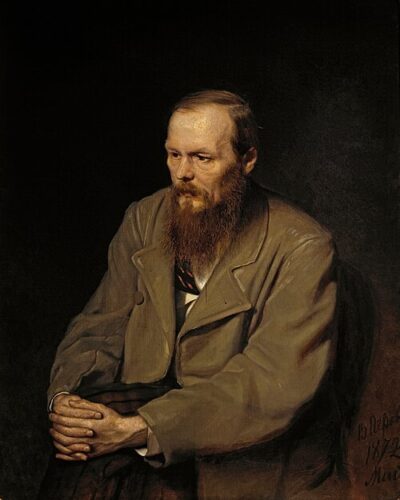
Notes from Underground
Notes from Underground is a 1864 novella by Fyodor Dostoyevsky.
- Published
- 1864
- Came out
- 1864
- Written by
- Fyodor Dostoyevsky
- Genre
- philosophical fiction
- Country of origin
- Russia
All 7 facts, and where they come from
Facts
7 facts · 0 confirmed by two sources · 0 cited · 7 from one source
Where this comes from
Papalocal keeps its own record. It started from these sources; what each one said is kept here as it was copied, so a change on their side never changes this page by itself. Tap one to read its version.
What Wikidata says · copied November 17, 2026 · revision 2565331924
- Described as
- 1864 novella by Fyodor Dostoyevsky
- What it is
- literary work
- Written by
- Fyodor Dostoyevsky
- Genre
- philosophical fiction
- Published
- 1864
- Language
- Russian
- Country of origin
- Russia
- Came out
- 1864
- Wikipedias with a page
- 50
Wikidata item Q695116 (wikidata.org/wiki/Q695116), public domain (CC0). Copied 2026-11-17.
What Wikipedia says · copied November 17, 2026 · revision 1384232841
Notes from Underground (pre-reform Russian: Записки изъ подполья; post-reform Russian: Записки из подполья, Zapíski iz podpólʹya; also translated as Notes from the Underground or Letters from the Underworld) is a novella by Russian author Fyodor Dostoevsky, first published in the journal Epoch in 1864. It is a first-person narrative in the form of a "confession". The work was originally announced by Dostoevsky in Epoch under the title "A Confession".
The novella presents itself as an excerpt from the memoirs of a bitter, isolated, unnamed narrator (generally referred to by critics as the Underground Man), who is a retired civil servant living in St. Petersburg. Although the first part of the novella has the form of a monologue, the narrator's form of address to his reader is acutely dialogized. According to Mikhail Bakhtin, in the Underground Man's confession "there is literally not a single monologically firm, undissociated word". The Underground Man's every word anticipates the words of an other, with whom he enters into an obsessive internal polemic.
The Underground Man attacks contemporary Russian philosophy, especially Nikolay Chernyshevsky's What Is to Be Done? Generally, the work can be viewed as an attack on determinism: the idea that everything, including the human personality and will, can be reduced to the laws of nature, science and mathematics.
From the Wikipedia article “Notes from Underground” (en.wikipedia.org/wiki/Notes_from_Underground), by its contributors, under CC BY-SA 4.0 (creativecommons.org/licenses/by-sa/4.0/). Copied 2026-11-17; not changed.
Confirmed Two sources agree. Cited One source, and it names where it got it. One source One source, without a reference of its own. Sources disagree The sources disagree. We show the best-supported value and keep theirs below.
Picture: Wikimedia Commons: Записки из подполья. Повесть Ф.М. Достоевского (1866) обложка.jpg · See Commons file page