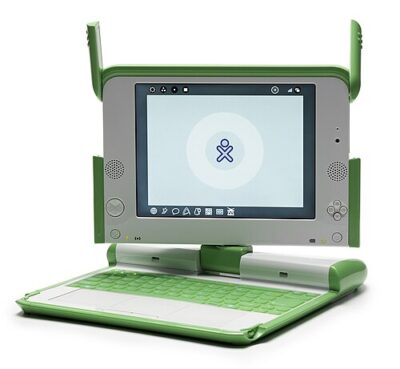
One Laptop per Child
One Laptop per Child is a non-profit initiative. It came out in 2005. Its headquarters are in Miami.
- Came out
- January 28, 2005
All 8 facts, and where they come from
Facts
8 facts · 0 confirmed by two sources · 0 cited · 8 from one source
Where this comes from
Papalocal keeps its own record. It started from these sources; what each one said is kept here as it was copied, so a change on their side never changes this page by itself. Tap one to read its version.
What Wikidata says · copied November 17, 2026 · revision 2569798286
- Described as
- non-profit initiative
- Other names
- OLPC
- What it is
- organization
- Came out
- January 28, 2005
- Ended
- 2014
- Founded by
- Nicholas Negroponte; Seymour Papert
- Headquarters
- Miami · 1 reference
- Country
- United States
- Official website
- https://one.laptop.org
- Wikipedias with a page
- 40
Wikidata item Q842120 (wikidata.org/wiki/Q842120), public domain (CC0). Copied 2026-11-17.
What Wikipedia says · copied November 17, 2026 · revision 1384604591
One Laptop per Child (OLPC) was a non-profit initiative that operated from 2005 to 2014 with the goal of transforming education for children around the world by creating and distributing educational devices for the developing world, and by creating software and content for those devices.
When the program launched, the typical retail price for a laptop was considerably in excess of $1,000 (US), so achieving this objective required bringing a low-cost machine to production. This became the OLPC XO Laptop, a low-cost and low-power laptop computer. The housing was styled by Yves Béhar with Continuum, now EPAM Continuum. The project was originally funded by member organizations such as AMD, eBay, Google, Marvell Technology Group, News Corporation, and Nortel. Chi Mei Corporation, Red Hat, and Quanta provided in-kind support. After disappointing sales, the hardware design part of the organization shut down in 2014.
The OLPC project was praised for pioneering low-cost, low-power laptops and inspiring later variants such as Eee PCs and Chromebooks; for assuring consensus at ministerial level in many countries that computer literacy is a mainstream part of education; for creating interfaces that worked without literacy in any language, and particularly without literacy in English.
It was criticized for its US-centric focus ignoring bigger problems, high total costs, low focus on maintainability and training and its limited success. A large-scale randomized study of 531 primary schools in rural Peru over 10 years found no significant effects on academic performance, primary and secondary completion, or university enrollment. The OLPC project is critically reviewed in a 2019 MIT Press book titled The Charisma Machine: The Life, Death, and Legacy of One Laptop per Child.
OLPC, Inc, a descendant of the original organization, continues to operate, but the design and creation of laptops is no longer part of its mission.
From the Wikipedia article “One Laptop per Child” (en.wikipedia.org/wiki/One_Laptop_per_Child), by its contributors, under CC BY-SA 4.0 (creativecommons.org/licenses/by-sa/4.0/). Copied 2026-11-17; not changed.
Confirmed Two sources agree. Cited One source, and it names where it got it. One source One source, without a reference of its own. Sources disagree The sources disagree. We show the best-supported value and keep theirs below.
Picture: Photo credit: "Mike McGregor"; upload to OLPC-Wiki: OLPC user "Walter", via Wikimedia Commons · CC BY 2.5