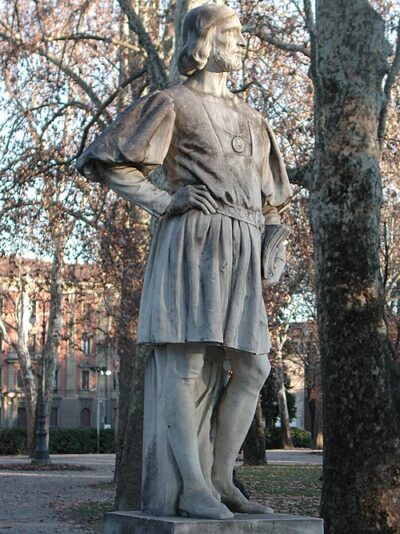
Orlando Furioso
Orlando Furioso is an epic Italian poem by Ludovico Ariosto. It came out in 1516. It is based on The Song of Roland.
- Published
- 1516
- Written by
- Ludovico Ariosto
- Genre
- chivalric romance
- Country of origin
- Italy
All 8 facts, and where they come from
Facts
8 facts · 0 confirmed by two sources · 0 cited · 8 from one source
Where this comes from
Papalocal keeps its own record. It started from these sources; what each one said is kept here as it was copied, so a change on their side never changes this page by itself. Tap one to read its version.
What Wikidata says · copied November 17, 2026 · revision 2537653355
- Described as
- epic Italian poem by Ludovico Ariosto
- Other names
- Orlando furioso
- What it is
- literary work
- Written by
- Ludovico Ariosto
- Genre
- chivalric romance
- Published
- 1516; 1532
- Language
- Italian
- Country of origin
- Italy
- Based on
- The Song of Roland; Orlando Innamorato
- Wikipedias with a page
- 44
Wikidata item Q48922 (wikidata.org/wiki/Q48922), public domain (CC0). Copied 2026-11-17.
What Wikipedia says · copied November 17, 2026 · revision 1384062962
Orlando furioso (Italian pronunciation: [orˈlando fuˈrjoːzo, -so]; The Frenzy of Orlando) is an Italian epic poem by Ludovico Ariosto which has exerted a wide influence on later culture. The earliest version appeared in 1516, although the poem was not published in its complete form until 1532. Orlando furioso is a continuation of Matteo Maria Boiardo's unfinished romance Orlando innamorato (Orlando in Love, published posthumously in 1495). In its historical setting and characters, it shares some features with the Old French La Chanson de Roland of the eleventh century, which tells of the death of Roland. The story is also a chivalric romance which stemmed from a tradition beginning in the Late Middle Ages and continuing in popularity in the 16th century and well into the 17th.
Orlando is the Christian knight known in French and English as Roland. The story takes place against the background of the war between Charlemagne's Christian paladins and the Saracen army that has invaded Europe and is attempting to overthrow the Christian empire. The poem is about knights and ladies, war and love, and the romantic ideal of chivalry. It mixes realism and fantasy, humor and tragedy. The stage is the entire world, plus a trip to the Moon. The large cast of characters features Christians and Saracens, soldiers and sorcerers, and fantastic creatures including a gigantic sea monster called the Orc and a flying horse called the hippogriff. Many themes are interwoven in its complicated episodic structure, but the most important are the paladin Orlando's unrequited love for the pagan princess Angelica, which drives him mad; the love between the female Christian warrior Bradamante and the Saracen Ruggiero, who are supposed to be the ancestors of Ariosto's patrons, the House of Este of Ferrara; and the war between Christian and Infidel.
The poem is divided into forty-six cantos which contain a varying number of eight-line stanzas in ottava rima (a rhyme scheme of abababcc). Ottava rima had been used in previous Italian romantic epics, including Luigi Pulci's Morgante and Boiardo's Orlando Innamorato. Ariosto's work is 38,736 lines long in total, making it one of the longest poems in European literature.
From the Wikipedia article “Orlando Furioso” (en.wikipedia.org/wiki/Orlando_Furioso), by its contributors, under CC BY-SA 4.0 (creativecommons.org/licenses/by-sa/4.0/). Copied 2026-11-17; not changed.
Confirmed Two sources agree. Cited One source, and it names where it got it. One source One source, without a reference of its own. Sources disagree The sources disagree. We show the best-supported value and keep theirs below.
Picture: Wikimedia Commons: Ariosto - Orlando Furioso, 1551 - 5918999 FERE001606 00005.tif · See Commons file page