
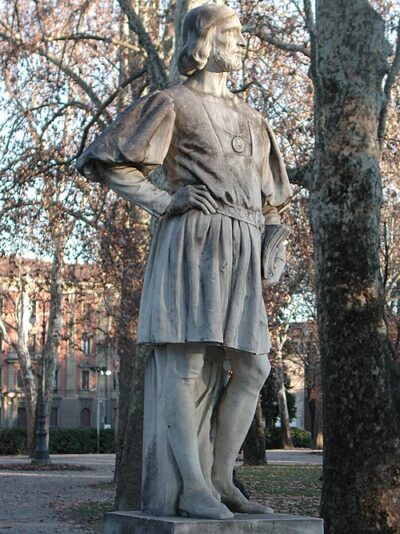
Ludovico Ariosto
Ludovico Ariosto was an Italian poet. Born September 8, 1474, in Reggio Emilia. Died July 6, 1533, in Ferrara. Known for Orlando Furioso. Educated at University of Ferrara. Awards include Poet's Crown.
Facts
17 facts · 2 confirmed by two sources · 4 cited · 11 from one source
Where this comes from
Papalocal keeps its own record. It started from these sources; what each one said is kept here as it was copied, so a change on their side never changes this page by itself. Tap one to read its version.
What Wikidata says · copied November 16, 2026 · revision 2565593538
- Described as
- Italian poet (1474–1533)
- Other names
- Lodovico Ariost, Lodovico Ariosto, Ariosto
- Born
- September 8, 1474 · 4 references
- Died
- July 6, 1533 · 4 references
- Born in
- Reggio Emilia · 2 references
- Died in
- Ferrara · 2 references
- Occupation
- poet · 4 references; playwright; writer · 1 reference
- Worked for
- University of Ferrara
- Education
- University of Ferrara
- Known for
- Orlando Furioso
- Awards
- Poet's Crown
- Field
- satire · 1 reference; poetry; dramaturgy
- Children
- Virginio Ariosto
- Siblings
- Gabriele Ariosto
- Religion
- Catholic Church
- Wikipedias with a page
- 92
Wikidata item Q48900 (wikidata.org/wiki/Q48900), public domain (CC0). Copied November 16, 2026.
What Wikipedia says · copied November 16, 2026 · revision 1382175829
Ludovico Ariosto (UK: , US: ; Italian: [ludoˈviːko aˈrjɔsto, - ariˈɔsto]; 8 September 1474 – 6 July 1533) was an Italian poet. He is best known as the author of the romance epic Orlando Furioso (1516-1532). The poem, a continuation of Matteo Maria Boiardo's Orlando Innamorato, describes the adventures of Charlemagne, Orlando, and the Franks as they battle against the Saracens with diversions into many sideplots. The poem is transformed into a satire of the chivalric tradition. Ariosto composed the poem in the ottava rima rhyme scheme and introduced narrative commentary throughout the work.
Ariosto also coined the term "humanism" (in Italian, umanesimo) for choosing to focus upon the strengths and potential of humanity, rather than only upon its role as subordinate to God. This led to Renaissance humanism.
- Born, in its opening lines
- September 8, 1474
- Died, in its opening lines
- July 6, 1533
From the Wikipedia article “Ludovico Ariosto” (en.wikipedia.org/wiki/Ludovico_Ariosto), by its contributors, under CC BY-SA 4.0 (creativecommons.org/licenses/by-sa/4.0/). Copied November 16, 2026; not changed.
Confirmed Two sources agree. Cited One source, and it names where it got it. One source One source, without a reference of its own. Sources disagree The sources disagree. We show the best-supported value and keep theirs below.
