Peer Gynt
Peer Gynt is a dramatic poem in five acts by the Norwegian dramatist Henrik Ibsen. It came out in 1867. It is based on Norwegian Huldre Fairy Tales and Folklore.
- Released
- November 14, 1867
- Came out
- 1867
- Written by
- Henrik Ibsen
- Genre
- verse drama
- Country of origin
- Norway
All 10 facts, and where they come from
Facts
10 facts · 0 confirmed by two sources · 9 cited · 1 from one source
Where this comes from
Papalocal keeps its own record. It started from these sources; what each one said is kept here as it was copied, so a change on their side never changes this page by itself. Tap one to read its version.
What Wikidata says · copied November 17, 2026 · revision 2561651450
- Described as
- dramatic poem in five acts by the Norwegian dramatist Henrik Ibsen
- What it is
- dramatic work · 1 reference
- Written by
- Henrik Ibsen · 2 references
- Music by
- Edvard Grieg · 2 references
- Genre
- verse drama · 4 references
- Released
- November 14, 1867 · 2 references
- Language
- Norwegian · 1 reference
- Country of origin
- Norway · 2 references
- Based on
- Norwegian Huldre Fairy Tales and Folklore · 1 reference; Per Gynt
- Came out
- 1867 · 1 reference
- Wikipedias with a page
- 46
Wikidata item Q208094 (wikidata.org/wiki/Q208094), public domain (CC0). Copied 2026-11-17.
What Wikipedia says · copied November 17, 2026 · revision 1359939148
Peer Gynt ( peer GHINT, Norwegian: [peːr ˈjʏnt, - ˈɡʏnt]) is a five-act play in verse written in 1867 by the Norwegian dramatist Henrik Ibsen. It is one of Ibsen's best known and most widely performed plays.
Peer Gynt chronicles the journey of its titular character from the Norwegian mountains to the North African desert and back. According to Klaus Van Den Berg, "its origins are Romantic, but the play also anticipates the fragmentations of emerging modernism" and the "cinematic script blends poetry with social satire and realistic scenes with surreal ones." Peer Gynt has also been described as the story of a life based on procrastination and avoidance.
Ibsen wrote Peer Gynt in deliberate disregard of the limitations that the conventional stagecraft of the 19th century imposed on drama. Its forty scenes move uninhibitedly in time and space and between consciousness and the unconscious, blending folkloric fantasy and unsentimental realism. Raymond Williams compares Peer Gynt with August Strindberg's early drama Lucky Peter's Journey (1882) and argues that both explore a new kind of dramatic action that was beyond the capacities of the theatre of the day; both created "a sequence of images in language and visual composition" that "became technically possible only in film."
Ibsen believed Per Gynt, a Norwegian fairy-tale by which the play is loosely inspired, to be rooted in fact. He also wrote that he had used his own family—the intertwined Ibsen/Paus family of Skien—and childhood memories as "some kind of model" for the Gynt family; he acknowledged that the character of Åse—Peer Gynt's mother—was based on his own mother, Marichen Altenburg, while Peer's father Jon Gynt is widely interpreted as based on Ibsen's father Knud Ibsen. He was also generally inspired by Peter Christen Asbjørnsen's collection of Norwegian fairy-tales, Huldre-Eventyr og Folkesagn, published in 1845.
The play was written in Italy, and a first edition of 1,250 copies was published on 14 November 1867 by the Danish publisher Gyldendal in Copenhagen. Although the first edition swiftly sold out, a reprint of two thousand copies, which followed after only fourteen days, did not sell out until seven years later. During Ibsen's lifetime, Denmark and Norway had a largely identical written language based on Danish, but Ibsen wrote Peer Gynt in a somewhat modernized Dano-Norwegian that included a number of distinct Norwegian words.
Peer Gynt was first performed in Christiania (now Oslo) on 24 February 1876, with original music composed by Edvard Grieg that includes some of today's most recognised classical pieces, "In the Hall of the Mountain King" and "Morning Mood". It was published in German translation in 1881, in English in 1892, and in French in 1896. The contemporary influence of the play continues into the twenty-first century; it is widely performed internationally both in traditional and in modern experimental productions.
While Bjørnstjerne Bjørnson admired the play's "satire on Norwegian egotism, narrowness, and self-sufficiency" and described it as "magnificent", Hans Christian Andersen, Georg Brandes and Clemens Petersen all joined the widespread hostility, with Petersen writing that the play was not poetry. Enraged by Petersen's criticisms in particular, Ibsen defended his work by arguing that it "is poetry; and if it isn't, it will become such. The conception of poetry in our country, in Norway, shall shape itself according to this book." Despite this defense of his poetic achievement in Peer Gynt, the play was his last to employ verse; from The League of Youth (1869) onwards, Ibsen was to write drama only in prose.
From the Wikipedia article “Peer Gynt” (en.wikipedia.org/wiki/Peer_Gynt), by its contributors, under CC BY-SA 4.0 (creativecommons.org/licenses/by-sa/4.0/). Copied 2026-11-17; not changed.
Confirmed Two sources agree. Cited One source, and it names where it got it. One source One source, without a reference of its own. Sources disagree The sources disagree. We show the best-supported value and keep theirs below.
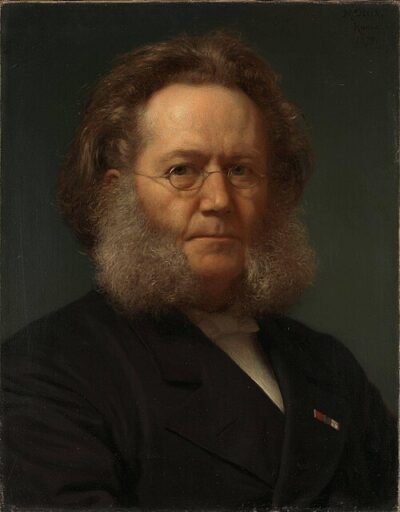
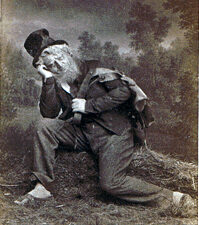
Picture: Ernst Emil Aubert, via Wikimedia Commons · Public domain