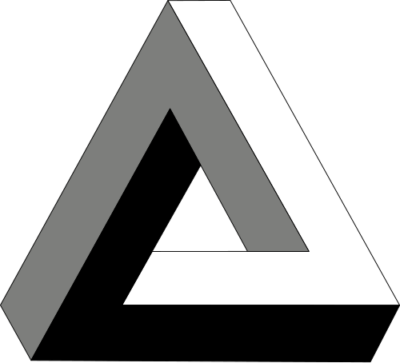
Penrose triangle
Penrose triangle is an impossible object.
All 4 facts, and where they come from
Facts
4 facts · 0 confirmed by two sources · 0 cited · 4 from one source
Where this comes from
Papalocal keeps its own record. It started from these sources; what each one said is kept here as it was copied, so a change on their side never changes this page by itself. Tap one to read its version.
What Wikidata says · copied November 17, 2026 · revision 2541718650
- Described as
- impossible object
- Other names
- Penrose tribar, impossible tribar, impossible triangle
- What it is
- impossible object; mathematical concept
- Named after
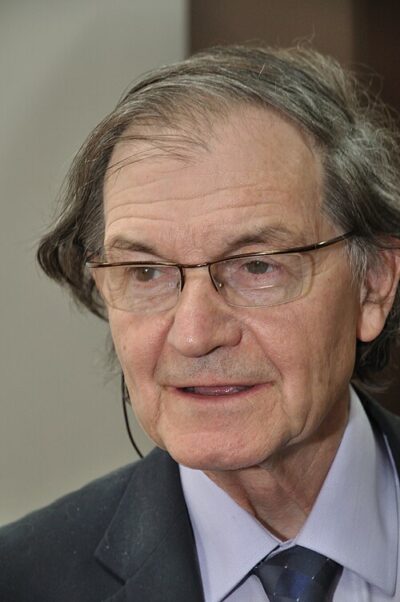
- Lionel Penrose; Roger Penrose
- Wikipedias with a page
- 41
Wikidata item Q12141 (wikidata.org/wiki/Q12141), public domain (CC0). Copied 2026-11-17.
What Wikipedia says · copied November 17, 2026 · revision 1359934919
The Penrose triangle, also known as the Penrose tribar, the impossible tribar, or the impossible triangle, is a triangular impossible object, an optical illusion consisting of an object that can be depicted in a perspective drawing. It cannot exist as a solid object in ordinary three-dimensional Euclidean space, although its surface can be embedded isometrically (bent but not stretched) in five-dimensional Euclidean space. It was first created by the Swedish artist Oscar Reutersvärd in 1934. Independently from Reutersvärd, the triangle was devised and popularized in the 1950s by psychiatrist Lionel Penrose and his son, the mathematician and Nobel Prize laureate Roger Penrose, who described it as "impossibility in its purest form". It is featured in the lithograph Waterfall (1961) by artist M. C. Escher, whose earlier depictions of impossible objects partly inspired it.
From the Wikipedia article “Penrose triangle” (en.wikipedia.org/wiki/Penrose_triangle), by its contributors, under CC BY-SA 4.0 (creativecommons.org/licenses/by-sa/4.0/). Copied 2026-11-17; not changed.
Confirmed Two sources agree. Cited One source, and it names where it got it. One source One source, without a reference of its own. Sources disagree The sources disagree. We show the best-supported value and keep theirs below.
Picture: Tobias R. – Metoc, via Wikimedia Commons · Public domain