
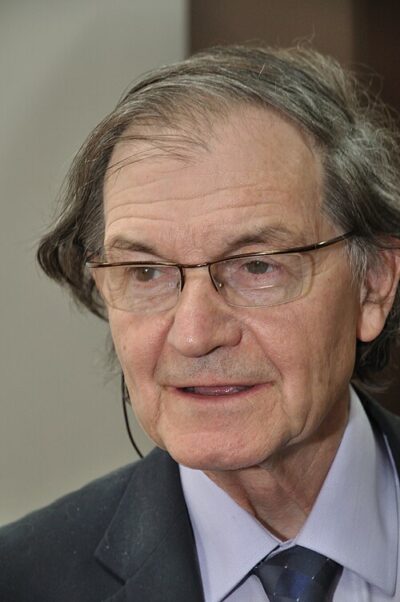
Roger Penrose
Roger Penrose is an English mathematical physicist, recreational mathematician and philosopher. Born August 8, 1931, in Colchester. Positions held include Rouse Ball Professor of Mathematics (1973–1999). Known for Penrose triangle, Penrose tiling and Penrose process. Educated at University College London and University of Cambridge. Awards include Fellow of the Royal Society, Copley Medal and Royal Medal.
Facts
62 facts · 1 confirmed by two sources · 29 cited · 32 from one source
Where this comes from
Papalocal keeps its own record. It started from these sources; what each one said is kept here as it was copied, so a change on their side never changes this page by itself. Tap one to read its version.
What Wikidata says · copied November 16, 2026 · revision 2568881100
- Described as
- English mathematical physicist, recreational mathematician and philosopher
- Other names
- R. Penrose, Sir Roger Penrose
- Born
- August 8, 1931 · 8 references
- Born in
- Colchester · 3 references
- Citizen of
- United Kingdom
- Occupation
- mathematician · 3 references; physicist · 1 reference; philosopher; university teacher · 2 references; astronomer · 1 reference; astrophysicist · 1 reference
- Positions held
- Rouse Ball Professor of Mathematics (1973–1999) · 1 reference
- Worked for
- Gresham College (1998–) · 1 reference; Birkbeck, University of London (1964–1973) · 1 reference; Leiden University (2011–); University of Oxford (1973–1998) · 1 reference
- Education
- University College London (–1955); University of Cambridge (1955–1958) · 1 reference; University College School (1945–) · 1 reference
- Member of
- Royal Society of London; Accademia Nazionale dei Lincei (2003–) · 1 reference; National Academy of Sciences (1998–) · 1 reference; Humanists UK; Oxford University Scientific Society; Polish Academy of Sciences · 1 reference; International Society on General Relativity and Gravitation · 1 reference; Academia Europaea (2019–) · 1 reference; American Philosophical Society (2011–)
- Known for
- Penrose triangle; Penrose tiling; Penrose process; Penrose diagram; The Emperor's New Mind; Fashion, Faith, and Fantasy in the New Physics of the Universe; The Road to Reality; Cycles of Time; The Nature of Space and Time; Shadows of the Mind
- Awards
- Fellow of the Royal Society (1972) · 1 reference; Copley Medal (2008) · 1 reference; Royal Medal (1985) · 1 reference; Adams Prize (1966) · 1 reference; Eddington Medal (1975) · 1 reference; IOP Dirac Medal (1989) · 2 references; Albert Einstein Medal (1990) · 1 reference; Naylor Prize and Lectureship (1991) · 1 reference; Helmholtz Medal (1998) · 2 references; Karl Schwarzschild Medal (2000) · 2 references; Marcel Grossmann Award (2000) · 1 reference; Josiah Willard Gibbs Lectureship (2000) · 1 reference; Order of Merit (2000) · 2 references; De Morgan Medal (2004) · 1 reference; Amaldi Medal (2004) · 1 reference
- Field
- physics · 1 reference; mathematical physics · 2 references; mathematics · 1 reference
- Spouse
- Vanessa Thomas (1988–) · 2 references; Joan Isabel Wedge (1959–1981) · 2 references
- Father
- Lionel Penrose · 2 references
- Mother
- Margaret Leathes · 2 references
- Siblings
- Shirley Hodgson; Jonathan Penrose · 1 reference; Oliver Penrose · 1 reference
- Religion
- agnosticism
- Wikipedias with a page
- 92
Wikidata item Q193803 (wikidata.org/wiki/Q193803), public domain (CC0). Copied November 16, 2026.
What Wikipedia says · copied November 16, 2026 · revision 1385680678
Sir Roger Penrose (born 8 August 1931) is an English mathematical physicist. He is Emeritus Rouse Ball Professor of Mathematics at the University of Oxford, an emeritus fellow of Wadham College, Oxford, and an honorary fellow of St John's College, Cambridge, and University College London. He shared the 1988 Wolf Prize in Physics with Stephen Hawking for the Penrose–Hawking singularity theorems, and the 2020 Nobel Prize in Physics "for the discovery that black hole formation is a robust prediction of the general theory of relativity". He proposed the Penrose triangle and corresponded with M. C. Escher, influencing his Waterfall and Ascending and Descending. Penrose's eponymous aperiodic tiling presaged Dan Shechtman's discovery of quasicrystals.
Penrose won the Royal Society Science Book Prize for The Emperor's New Mind (1989), which outlines his views on physics and consciousness. He expanded on these ideas in Shadows of the Mind (1994) and The Large, the Small and the Human Mind (1997), the latter written with Stuart Hameroff. His The Road to Reality, (2004), billed as "A Complete Guide to the Laws of the Universe", is an overview of mathematical physics.
- Born, in its opening lines
- August 8, 1931
From the Wikipedia article “Roger Penrose” (en.wikipedia.org/wiki/Roger_Penrose), by its contributors, under CC BY-SA 4.0 (creativecommons.org/licenses/by-sa/4.0/). Copied November 16, 2026; not changed.
Confirmed Two sources agree. Cited One source, and it names where it got it. One source One source, without a reference of its own. Sources disagree The sources disagree. We show the best-supported value and keep theirs below.
