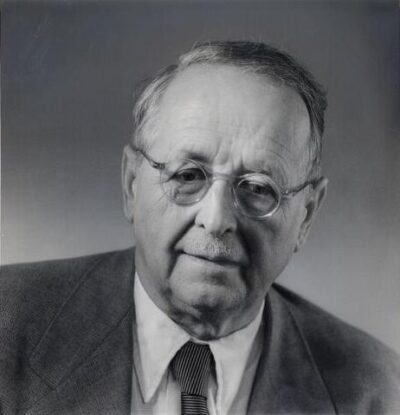
Peter–Weyl theorem
Peter–Weyl theorem is a theorem.
All 3 facts, and where they come from
Facts
3 facts · 0 confirmed by two sources · 0 cited · 3 from one source
Where this comes from
Papalocal keeps its own record. It started from these sources; what each one said is kept here as it was copied, so a change on their side never changes this page by itself. Tap one to read its version.
What Wikidata says · copied November 16, 2026 · revision 2558889327
- Described as
- theorem
- What it is
- theorem
- Named after
- Fritz Peter · 1 reference; Hermann Weyl · 1 reference
- Wikipedias with a page
- 9
Wikidata item Q1529941 (wikidata.org/wiki/Q1529941), public domain (CC0). Copied 2026-11-16.
What Wikipedia says · copied November 16, 2026 · revision 1384723108
In mathematics, the Peter–Weyl theorem is a basic result in the theory of harmonic analysis, applying to topological groups that are compact, but are not necessarily abelian. It was initially proved by Hermann Weyl, with his student Fritz Peter, in the setting of a compact topological group G (Peter & Weyl 1927). The theorem is a collection of results generalizing the significant facts about the decomposition of the regular representation of any finite group, as discovered by Ferdinand Georg Frobenius and Issai Schur.
Let G be a compact group. The theorem has three parts. The first part states that the matrix coefficients of irreducible representations of G are dense in the space C(G) of continuous complex-valued functions on G, and thus also in the space L2(G) of square-integrable functions. The second part asserts the complete reducibility of unitary representations of G. The third part then asserts that the regular representation of G on L2(G) decomposes as the direct sum of all irreducible unitary representations. Moreover, the matrix coefficients of the irreducible unitary representations form an orthonormal basis of L2(G). In the case that G is the group of unit complex numbers, this last result is simply a standard result from Fourier series.
From the Wikipedia article “Peter–Weyl theorem” (en.wikipedia.org/wiki/Peter–Weyl_theorem), by its contributors, under CC BY-SA 4.0 (creativecommons.org/licenses/by-sa/4.0/). Copied 2026-11-16; not changed.
Confirmed Two sources agree. Cited One source, and it names where it got it. One source One source, without a reference of its own. Sources disagree The sources disagree. We show the best-supported value and keep theirs below.