
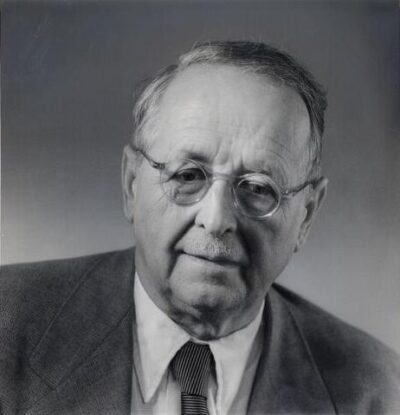
Hermann Weyl
Hermann Weyl was a German mathematician. Born November 9, 1885, in Elmshorn. Died December 8, 1955, in Zurich. Known for Weyl tensor, Weyl equation and Weyl group. Educated at University of Göttingen and LMU Munich. Awards include Josiah Willard Gibbs Lectureship, Lobachevsky Prize and Fellow of the American Physical Society.
Facts
59 facts · 2 confirmed by two sources · 24 cited · 33 from one source
Where this comes from
Papalocal keeps its own record. It started from these sources; what each one said is kept here as it was copied, so a change on their side never changes this page by itself. Tap one to read its version.
What Wikipedia says · copied November 13, 2026 · revision 1385441063
Hermann Klaus Hugo Weyl ( VILE; German: [vaɪl]; 9 November 1885 – 8 December 1955) was a German mathematician, theoretical physicist, logician and philosopher. He was one of the most influential mathematicians of the twentieth century. Although much of his working life was spent in Zürich, Switzerland, and then Princeton, New Jersey, he is associated with the University of Göttingen tradition of mathematics, represented by Carl Friedrich Gauss, David Hilbert and Hermann Minkowski.
Weyl made significant contributions to an exceptionally wide range of intellectual fields, including mathematics, physics, philosophy and logic, with interests extending to the nature of space, time, matter and symmetry, as well as the history of mathematics. The originator of gauge theory, which became a fundamental framework of particle physics, Weyl was a pioneer in applying group theory to quantum mechanics, and made foundational contributions to many branches of mathematics such as differential geometry and number theory. He developed or introduced concepts and results such as gauge invariance, the Peter–Weyl theorem, equidistribution theorem and the Weyl law.
He was one of the first to conceive of combining general relativity with the laws of electromagnetism. In cosmology, he theoretically derived the linear redshift–distance relation later known as Hubble's redshift law, several years before Hubble's observations.
An important member of the Institute for Advanced Study during its early years, Weyl conceived of mathematics as an organic whole, a view informed by his philosophical outlook, and this conception shaped his work across disciplines. Freeman Dyson wrote that Weyl alone bore comparison with the "last great universal mathematicians of the nineteenth century", Henri Poincaré and David Hilbert. Vladimir Arnold and Aleksei Parshin said that his mathematical, philosophical, physical and literary breadth made him “a phenomenon of twentieth-century German culture in entirety".
- Born, in its opening lines
- November 9, 1885
- Died, in its opening lines
- December 8, 1955
From the Wikipedia article “Hermann Weyl” (en.wikipedia.org/wiki/Hermann_Weyl), by its contributors, under CC BY-SA 4.0 (creativecommons.org/licenses/by-sa/4.0/). Copied November 13, 2026; not changed.
What Wikidata says · copied November 14, 2026 · revision 2569002334
- Described as
- German mathematician (1885–1955)
- Other names
- Hermann Klaus Hugo Weyl
- Born
- November 9, 1885 · 11 references
- Died
- December 8, 1955 · 3 references
- Born in
- Elmshorn · 2 references
- Died in
- Zurich · 3 references
- Buried in
- Princeton Cemetery
- Name at birth
- Hermann Klaus Hugo Weyl
- Citizen of
- German Empire · 1 reference; Weimar Republic; United States; Switzerland · 1 reference
- Occupation
- mathematician · 2 references; physicist · 1 reference; philosopher · 1 reference; university teacher
- Worked for
- University of Göttingen (2 times) (1909–1933) · 1 reference; Institute for Advanced Study (1933–1952); ETH Zurich (1913–1930) · 2 references
- Education
- University of Göttingen (1904–1908) · 1 reference; LMU Munich (1905–1906) · 1 reference; Christianeum
- Member of
- Royal Society of London (1936–) · 1 reference; Pontifical Academy of Sciences · 1 reference; American Academy of Arts and Sciences (1929–); German Academy of Sciences Leopoldina (1923–) · 1 reference; American Physical Society (1928–); London Mathematical Society (1939) · 1 reference; Bavarian Academy of Sciences and Humanities; National Academy of Sciences; Göttingen Academy of Sciences and Humanities in Lower Saxony; American Philosophical Society (1935–)
- Known for
- Weyl tensor; Weyl equation; Weyl group; Weyl algebra; Peter–Weyl theorem; Weyl's inequality; Weyl–Brauer matrices; Weyl curvature hypothesis; Weyl–Lewis–Papapetrou coordinates; Wigner–Weyl transform
- Awards
- Josiah Willard Gibbs Lectureship (1948); Lobachevsky Prize (1927) · 1 reference; Fellow of the American Physical Society; honorary doctorate of the University of Oslo; honorary doctorate from Columbia University; honorary doctor of ETH Zürich; Foreign Member of the Royal Society (1936) · 1 reference; honorary doctor of the University of Stuttgart; Arnold-Reymond prize (1954) · 1 reference; doctor honoris causa from the University of Paris (1952) · 1 reference
- Field
- differential geometry; number theory; mathematics · 2 references; group theory · 1 reference; theoretical physics · 2 references; quantum mechanics · 1 reference
- Spouse
- Helene Weyl · 1 reference
- Children
- Fritz Joachim Weyl · 1 reference; Michael Weyl
- Wikipedias with a page
- 78
Wikidata item Q71029 (wikidata.org/wiki/Q71029), public domain (CC0). Copied November 14, 2026.
Confirmed Two sources agree. Cited One source, and it names where it got it. One source One source, without a reference of its own. Sources disagree The sources disagree. We show the best-supported value and keep theirs below.
