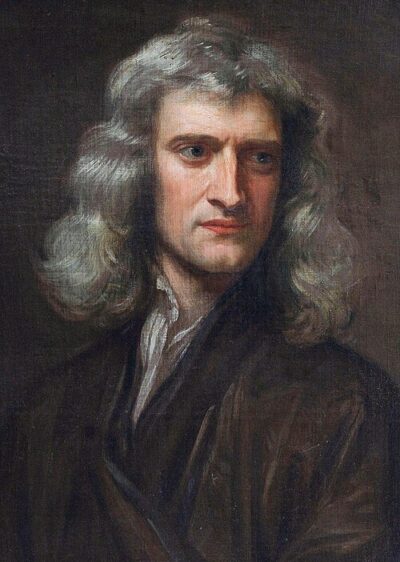
Philosophiæ Naturalis Principia Mathematica
Philosophiæ Naturalis Principia Mathematica is a 1687 work by Isaac Newton describing his laws of motion and gravitation. It is based on De motu corporum in gyrum.
- Published
- 1687
- Came out
- 1680
- Written by
- Isaac Newton
- Genre
- natural philosophy
All 11 facts, and where they come from
Facts
11 facts · 0 confirmed by two sources · 3 cited · 8 from one source
Where this comes from
Papalocal keeps its own record. It started from these sources; what each one said is kept here as it was copied, so a change on their side never changes this page by itself. Tap one to read its version.
What Wikidata says · copied November 17, 2026 · revision 2557059473
- Described as
- 1687 work by Isaac Newton describing his laws of motion and gravitation
- Other names
- Mathematical Principles of Natural Philosophy, The Mathematical Principles of Natural Philosophy, Philosophiae Naturalis Principia Mathematica, Principia
- What it is
- written work; treatise; academic work
- Written by
- Isaac Newton · 1 reference
- Genre
- natural philosophy; classical mechanics
- Published
- 1687 · 1 reference
- Language
- Latin
- Based on
- De motu corporum in gyrum · 1 reference; Galileo Galilei
- Came out
- 1680
- Wikipedias with a page
- 80
Wikidata item Q205921 (wikidata.org/wiki/Q205921), public domain (CC0). Copied 2026-11-17.
What Wikipedia says · copied November 17, 2026 · revision 1385984571
Philosophiæ Naturalis Principia Mathematica (English: The Mathematical Principles of Natural Philosophy), often called simply the Principia (), is a book by Sir Isaac Newton that expounds Newton's laws of motion and his law of universal gravitation.
The Principia is written in Latin and comprises three volumes, and was authorized (imprimatur) by Samuel Pepys, then-president of the Royal Society on 5 July 1686 and first published in 1687. After annotating and correcting his personal copy of the first edition, Newton published two further editions, one of 1713 with errors in the 1687 version corrected, and another, improved one of 1726.
The Principia forms a mathematical foundation for the theory of classical mechanics, and is generally considered to be one of the most important works in the history of science. It has been referred to as "the greatest scientific work in history" and "the supreme expression in human thought of the mind's ability to hold the universe fixed as an object of contemplation".
Recent research has challenged the long-held view that the Principia had only a limited initial readership, suggesting that its early influence on Enlightenment science was substantially greater than previously recognized.
In formulating his physical laws, Newton developed and used mathematical methods now included in the field of calculus, expressing them in the form of geometric propositions about "vanishingly small" shapes. In a revised conclusion to the Principia (see § General Scholium), Newton emphasized the empirical nature of the work with the expression Hypotheses non fingo ("I frame/feign no hypotheses"). Among other achievements, Newton provides an explanation for Johannes Kepler's laws of planetary motion, which Kepler had obtained empirically. Newton also set out four rules of scientific reasoning that helped shape modern approaches to science.
From the Wikipedia article “Philosophiæ Naturalis Principia Mathematica” (en.wikipedia.org/wiki/Philosophiæ_Naturalis_Principia_Mathematica), by its contributors, under CC BY-SA 4.0 (creativecommons.org/licenses/by-sa/4.0/). Copied 2026-11-17; not changed.
Confirmed Two sources agree. Cited One source, and it names where it got it. One source One source, without a reference of its own. Sources disagree The sources disagree. We show the best-supported value and keep theirs below.
Picture: Wikimedia Commons: Newton's Principia title page.png · See Commons file page