
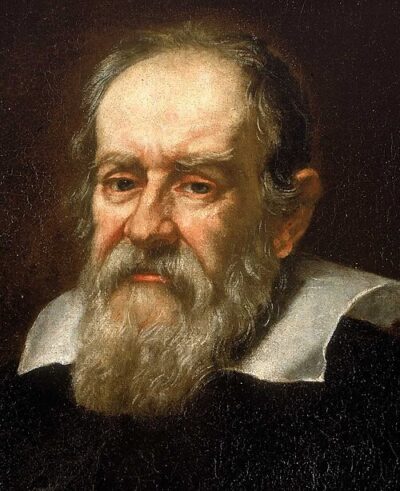
Galileo Galilei
Galileo Galilei was an Italian polymath. Born February 15, 1564, in Pisa. Died January 8, 1642, in Arcetri. Known for Galilean transformation and equations for a falling body. Educated at University of Pisa. Awards include International Space Hall of Fame.
Facts
39 facts · 2 confirmed by two sources · 15 cited · 22 from one source
Where this comes from
Papalocal keeps its own record. It started from these sources; what each one said is kept here as it was copied, so a change on their side never changes this page by itself. Tap one to read its version.
What Wikidata says · copied November 16, 2026 · revision 2565530349
- Described as
- Italian polymath (1564–1642)
- Other names
- Galileo di Vincenzo Bonaiuti de' Galilei, Galileo, Galilei, G. Galilei
- Born
- February 15, 1564 · 5 references
- Died
- January 8, 1642 · 16 references
- Born in
- Pisa · 4 references
- Died in
- Arcetri · 3 references
- Buried in
- Basilica of Santa Croce · 1 reference
- Name at birth
- Galileo di Vincenzo Bonaiuti de' Galilei
- Citizen of
- Duchy of Florence (–1569); Grand Duchy of Tuscany (1569–)
- Occupation
- astronomer · 4 references; philosopher · 2 references; mathematician · 3 references; physicist · 3 references; inventor; astrologer; university teacher · 1 reference; scientist · 3 references
- Worked for
- University of Padua (1592–) · 1 reference; University of Pisa (1589–) · 1 reference
- Education
- University of Pisa (1581–1585) · 2 references
- Member of
- Accademia della Crusca (1605–); Accademia dei Lincei; Accademia delle Arti del Disegno
- Known for
- Galilean transformation; equations for a falling body
- Awards
- International Space Hall of Fame (1991) · 2 references
- Field
- astronomy; physics; mechanics; philosophy; mathematics · 1 reference
- Children
- Vincenzo Gamba; Maria Celeste · 1 reference
- Father
- Vincenzo Galilei · 1 reference
- Mother
- Giulia Ammannati
- Siblings
- Michelagnolo Galilei · 1 reference
- Religion
- Latin Church · 1 reference
- Lived in
- Pisa; Padua; Florence
- Wikipedias with a page
- 271
Wikidata item Q307 (wikidata.org/wiki/Q307), public domain (CC0). Copied November 16, 2026.
What Wikipedia says · copied November 16, 2026 · revision 1385604897
Galileo di Vincenzo Bonaiuti de' Galilei (15 February 1564 – 8 January 1642), commonly referred to as Galileo Galilei or mononymously as Galileo, was an Italian astronomer, physicist, engineer and polymath. He was born in Pisa, then part of the Duchy of Florence. Galileo has been called the father of observational astronomy, classical physics, the scientific method, and modern science.
He studied speed and velocity, gravity and free fall, the principle of relativity, inertia, projectile motion, and also worked in applied science and technology, describing the properties of the pendulum and "hydrostatic balances". He was one of the earliest developers of the thermoscope and the inventor of various military compasses. With an improved telescope he built, he observed the stars of the Milky Way, the phases of Venus, the four largest satellites of Jupiter, Saturn's rings, lunar craters, and sunspots. He also built an early microscope.
Galileo's championing of Copernican heliocentrism was met with opposition from within the Catholic Church and from some astronomers. The matter was investigated by the Roman Inquisition in 1615, which concluded that his opinions contradicted accepted Biblical interpretations.
Galileo defended his views in Dialogo sopra i due massimi sistemi del mondo
(Dialogue Concerning the Two Chief World Systems, 1632), which appeared to dispute and satirize Pope Urban VIII, thus alienating both the Pope and the Jesuits, who had both strongly supported Galileo until this point. He was tried by the Inquisition, found "vehemently suspect of heresy", and forced to recant. He spent the rest of his life under house arrest. During this time, he wrote Discorsi e Dimostrazioni Matematiche, intorno a due nuove scienze (Discourses and Mathematical Demonstrations Relating to Two New Sciences, 1638) primarily about kinematics and the strength of materials.
- Born, in its opening lines
- February 15, 1564
- Died, in its opening lines
- January 8, 1642
From the Wikipedia article “Galileo Galilei” (en.wikipedia.org/wiki/Galileo_Galilei), by its contributors, under CC BY-SA 4.0 (creativecommons.org/licenses/by-sa/4.0/). Copied November 16, 2026; not changed.
Confirmed Two sources agree. Cited One source, and it names where it got it. One source One source, without a reference of its own. Sources disagree The sources disagree. We show the best-supported value and keep theirs below.
