Poincaré disk model
Poincaré disk model is a model of hyperbolic geometry.
All 3 facts, and where they come from
Facts
3 facts · 0 confirmed by two sources · 0 cited · 3 from one source
Where this comes from
Papalocal keeps its own record. It started from these sources; what each one said is kept here as it was copied, so a change on their side never changes this page by itself. Tap one to read its version.
What Wikidata says · copied November 17, 2026 · revision 2541643860
- Described as
- model of hyperbolic geometry
- Other names
- Poincaré ball model, conformal disk model, Poincaré disc model, conformal disc model, Poincare disk model, Poincare ball model, Poincare disc model
- What it is
- model; hyperbolic space
- Named after
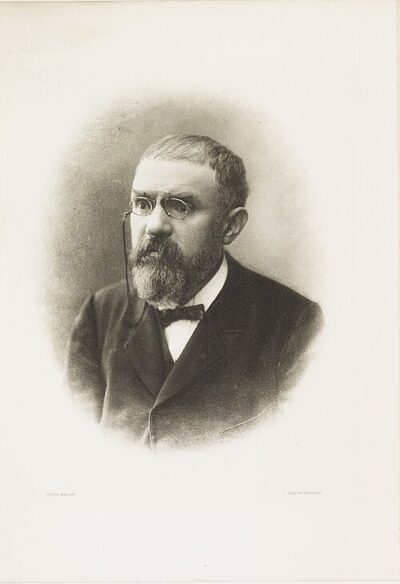
- Henri Poincaré
- Wikipedias with a page
- 15
Wikidata item Q2617832 (wikidata.org/wiki/Q2617832), public domain (CC0). Copied 2026-11-17.
What Wikipedia says · copied November 17, 2026 · revision 1334133907
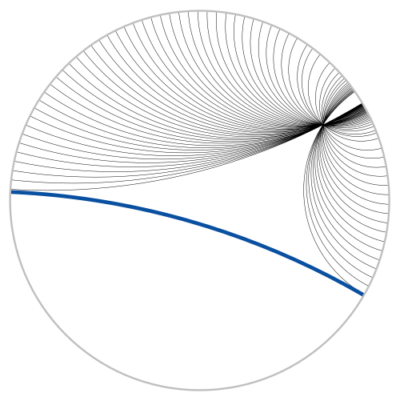
In geometry, the Poincaré disk model, also called the conformal disk model, is a model of 2-dimensional hyperbolic geometry in which all points are inside the unit disk, and straight lines are either circular arcs contained within the disk that are orthogonal to the unit circle or diameters of the unit circle.
The group of orientation preserving isometries of the disk model is given by the projective special unitary group PSU(1,1), the quotient of the special unitary group SU(1,1) by its center {I, −I}.
Along with the Klein model and the Poincaré half-space model, it was proposed by Eugenio Beltrami who used these models to show that hyperbolic geometry was equiconsistent with Euclidean geometry. It is named after Henri Poincaré, because his rediscovery of this representation fourteen years later became better known than the original work of Beltrami.
The Poincaré ball model is the similar model for 3 or n-dimensional hyperbolic geometry in which the points of the geometry are in the n-dimensional unit ball.
From the Wikipedia article “Poincaré disk model” (en.wikipedia.org/wiki/Poincaré_disk_model), by its contributors, under CC BY-SA 4.0 (creativecommons.org/licenses/by-sa/4.0/). Copied 2026-11-17; not changed.
Confirmed Two sources agree. Cited One source, and it names where it got it. One source One source, without a reference of its own. Sources disagree The sources disagree. We show the best-supported value and keep theirs below.
Picture: Trevorgoodchild, via Wikimedia Commons · Public domain