
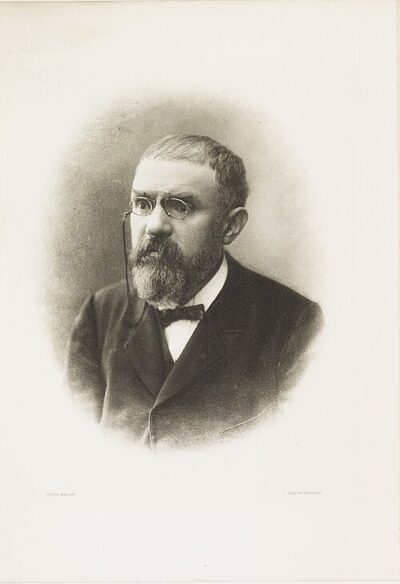
Henri Poincaré
Henri Poincaré was a French mathematician, physicist and engineer. Born April 29, 1854, in Nancy. Died July 17, 1912, in Paris. Positions held include president of the Mathematical Society of France (2 times) (1886–1900), Member of the Académie française (1908–1912) and president of the French Academy of Sciences (1906). Known for Poincaré conjecture, Poincaré group and Poincaré recurrence theorem. Educated at Mines ParisTech and lycée Henri-Poincaré. Awards include Poncelet Prize, Sylvester Medal and Commander of the Legion of Honour.
Facts
71 facts · 2 confirmed by two sources · 24 cited · 45 from one source
Where this comes from
Papalocal keeps its own record. It started from these sources; what each one said is kept here as it was copied, so a change on their side never changes this page by itself. Tap one to read its version.
What Wikidata says · copied November 16, 2026 · revision 2565595898
- Described as
- French mathematician, physicist and engineer (1854–1912)
- Other names
- Jules Henri Poincare, Henri Poincare, Poincare, Jules Henri Poincaré, Poincaré
- Born
- April 29, 1854 · 13 references
- Died
- July 17, 1912 · 13 references
- Born in
- Nancy · 3 references
- Died in
- Paris · 2 references
- Buried in
- Montparnasse Cemetery · 2 references
- Cause of death
- embolism
- Name at birth
- Jules Henri Poincaré
- Citizen of
- France · 1 reference
- Occupation
- mathematician · 1 reference; philosopher; astronomer · 1 reference; physicist · 1 reference; engineer; philosopher of science; topologist; university teacher
- Positions held
- president of the Mathematical Society of France (2 times) (1886–1900) · 1 reference; Member of the Académie française (1908–1912) · 1 reference; president of the French Academy of Sciences (1906) · 1 reference
- Worked for
- University of Paris (1881–1912) · 1 reference; École polytechnique (1886–1912) · 1 reference; Corps des mines (1877–1879) · 1 reference; University of Caen Normandy (1879–1881) · 1 reference
- Education
- Mines ParisTech (1875–); lycée Henri-Poincaré (1862–1873) · 1 reference; École polytechnique (1873–1875) · 1 reference; University of Paris (–1879) · 2 references
- Member of
- Académie Française (1908–1912) · 1 reference; French Academy of Sciences (1908–) · 1 reference; Bavarian Academy of Sciences and Humanities; Göttingen Academy of Sciences and Humanities in Lower Saxony; Saint Petersburg Academy of Sciences; Royal Swedish Academy of Sciences; Hungarian Academy of Sciences; Royal Society of London (1894–) · 1 reference; Royal Netherlands Academy of Arts and Sciences; Académie de Stanislas (Nancy, France)
- Known for
- Poincaré conjecture; Poincaré group; Poincaré recurrence theorem; Poincaré disk model; Poincaré duality; Poincaré inequality; Poincaré map; Poincaré–Bendixson theorem; Poincaré–Hopf theorem; Poincaré half-plane model
- Awards
- Poncelet Prize (1885); Sylvester Medal (1901); Commander of the Legion of Honour (1903); Gold Medal of the Royal Astronomical Society (1900); Bruce Medal (1911) · 1 reference; Bolyai Prize (1905); Matteucci Medal (1905) · 1 reference; Royal Order of the Polar Star (1905) · 1 reference; Concours général (1873) · 1 reference; Foreign Member of the Royal Society (1894) · 1 reference; Jean Reynaud Prize (1896) · 1 reference
- Field
- algebraic geometry; mathematical analysis; geometry; topology; mathematics · 1 reference; mechanics · 1 reference
- Spouse
- Jeanne-Louise Poulain d'Andecy
- Children
- Jeanne Poincaré; Léon Poincaré
- Father
- Émile-Léon Poincaré
- Siblings
- Aline Boutroux
- Religion
- atheism
- Lived in
- France · 1 reference
- Wikipedias with a page
- 131
Wikidata item Q81082 (wikidata.org/wiki/Q81082), public domain (CC0). Copied November 16, 2026.
What Wikipedia says · copied November 16, 2026 · revision 1385536432
Jules Henri Poincaré (UK: , US: ; French: [ɑ̃ʁi pwɛ̃kaʁe] ; 29 April 1854 – 17 July 1912) was a French mathematician, theoretical physicist, engineer, and philosopher of science. He is often described as a polymath, and in mathematics as "The Last Universalist", since he excelled in all fields of the discipline as it existed during his lifetime. He has further been called "the Gauss of modern mathematics". Due to his success in science, along with his influence in philosophy, he has also been called "the philosopher par excellence of modern science".
As a mathematician and physicist, he made many original fundamental contributions to pure and applied mathematics, mathematical physics, and celestial mechanics. In his research on the three-body problem, Poincaré became the first person to discover a chaotic deterministic system which laid the foundations of modern chaos theory. Poincaré is regarded as the creator of the field of algebraic topology, and is further credited with introducing automorphic forms. He also made important contributions to algebraic geometry, number theory, complex analysis and Lie theory. He famously introduced the concept of the Poincaré recurrence theorem, which states that a state will eventually return arbitrarily close to its initial state after a sufficiently long time, which has far-reaching consequences. Early in the 20th century he formulated the Poincaré conjecture, which became, over time, one of the famous unsolved problems in mathematics. It was eventually solved in 2002–2003 by Grigori Perelman. Poincaré popularized the use of non-Euclidean geometry in mathematics as well.
Poincaré made clear the importance of paying attention to the invariance of laws of physics under different transformations, and was the first to present the Lorentz transformations in their modern symmetrical form. Poincaré discovered the remaining relativistic velocity transformations and recorded them in a letter to Hendrik Lorentz in 1905. Thus he obtained perfect invariance of all of Maxwell's equations, an important step in the formulation of the theory of special relativity, for which he is also credited with laying down the foundations, further writing foundational papers in 1905. He first proposed gravitational waves (ondes gravifiques) emanating from a body and propagating at the speed of light as being required by the Lorentz transformations, doing so in 1905. In 1912, he wrote an influential paper which provided a mathematical argument for quantum mechanics. The Poincaré group used in physics and mathematics was named after him, after he introduced the notion of the group.
Poincaré was considered the dominant figure in mathematics and theoretical physics during his time, and was the most respected mathematician of his time, being described as "the living brain of the rational sciences" by mathematician Paul Painlevé. Philosopher Karl Popper regarded Poincaré as the greatest philosopher of science of all time, with Poincaré also originating the conventionalist view in science. He served as the president of the French Academy of Sciences (1906), the president of Société astronomique de France (1901–1903), and twice the president of Société mathématique de France (1886, 1900).
- Born, in its opening lines
- April 29, 1854
- Died, in its opening lines
- July 17, 1912
From the Wikipedia article “Henri Poincaré” (en.wikipedia.org/wiki/Henri_Poincaré), by its contributors, under CC BY-SA 4.0 (creativecommons.org/licenses/by-sa/4.0/). Copied November 16, 2026; not changed.
Confirmed Two sources agree. Cited One source, and it names where it got it. One source One source, without a reference of its own. Sources disagree The sources disagree. We show the best-supported value and keep theirs below.
