Poincaré half-plane model
Poincaré half-plane model is an upper-half plane model of hyperbolic non-Euclidean geometry.
All 4 facts, and where they come from
Facts
4 facts · 0 confirmed by two sources · 0 cited · 4 from one source
Where this comes from
Papalocal keeps its own record. It started from these sources; what each one said is kept here as it was copied, so a change on their side never changes this page by itself. Tap one to read its version.
What Wikidata says · copied November 17, 2026 · revision 2541643893
- Described as
- upper-half plane model of hyperbolic non-Euclidean geometry
- Other names
- Poincare half-plane model, Poincaré half-plane, Poincaré plane
- What it is
- mathematical model; Riemannian manifold; hyperbolic space
- Named after
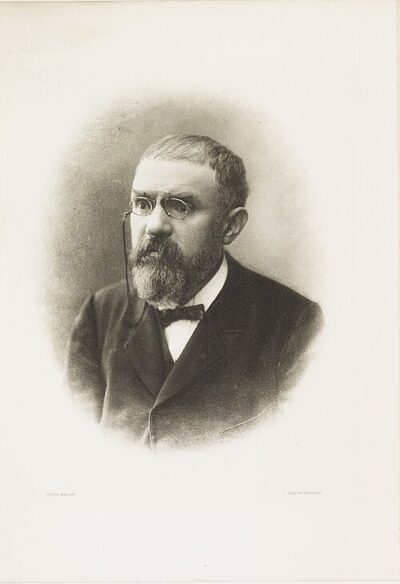
- Henri Poincaré
- Wikipedias with a page
- 11
Wikidata item Q2534886 (wikidata.org/wiki/Q2534886), public domain (CC0). Copied 2026-11-17.
What Wikipedia says · copied November 17, 2026 · revision 1352342714
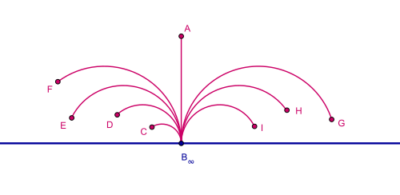
In non-Euclidean geometry, the Poincaré half-plane model is a way of representing the hyperbolic plane using points in the familiar Euclidean plane. Specifically, each point in the hyperbolic plane is represented using a Euclidean point with coordinates ⟨x,y⟩ whose y coordinate is greater than zero, the upper half-plane, and a metric tensor (definition of distance) called the Poincaré metric is adopted, in which the local scale is inversely proportional to the y coordinate. Points on the x-axis, whose y coordinate is equal to zero, represent ideal points (points at infinity), which are outside the hyperbolic plane proper.
Sometimes the points of the half-plane model are considered to lie in the complex plane with positive imaginary part. Using this interpretation, each point in the hyperbolic plane is associated with a complex number.
The half-plane model can be thought of as a map projection from the curved hyperbolic plane to the flat Euclidean plane. From the hyperboloid model (a representation of the hyperbolic plane on a hyperboloid of two sheets embedded in 3-dimensional Minkowski space, analogous to the sphere embedded in 3-dimensional Euclidean space), the half-plane model is obtained by orthographic projection in a direction parallel to a null vector, which can also be thought of as a kind of stereographic projection centered on an ideal point. The projection is conformal, meaning that it preserves angles, and like the stereographic projection of the sphere it projects generalized circles (geodesics, hypercycles, horocycles, and circles) in the hyperbolic plane to generalized circles (lines or circles) in the plane. In particular, geodesics (analogous to straight lines), project to either half-circles whose center has y coordinate zero, or to vertical straight lines of constant x coordinate, hypercycles project to circles crossing the x-axis, horocycles project to either circles tangent to the x-axis or to horizontal lines of constant y coordinate, and circles project to circles contained entirely in the half-plane.
Hyperbolic motions, the distance-preserving geometric transformations from the hyperbolic plane to itself, are represented in the Poincaré half-plane by the subset of Möbius transformations of the plane which preserve the half-plane; these are conformal, circle-preserving transformations which send the x-axis to itself without changing its orientation. When points in the plane are taken to be complex numbers, any Möbius transformation is represented by a linear fractional transformation of complex numbers, and the hyperbolic motions are represented by elements of the projective special linear group PSL2(ℝ).
The Cayley transform provides an isometry between the half-plane model and the Poincaré disk model, which is a stereographic projection of the hyperboloid centered on any ordinary point in the hyperbolic plane, which maps the hyperbolic plane onto a disk in the Euclidean plane, and also shares the properties of conformality and mapping generalized circles to generalized circles.
The Poincaré half-plane model is named after Henri Poincaré, but it originated with Eugenio Beltrami who used it, along with the Klein model and the Poincaré disk model, to show that hyperbolic geometry was equiconsistent with Euclidean geometry.
The half-plane model can be generalized to the Poincaré half-space model of (n+1)-dimensional hyperbolic space by replacing the single x coordinate by n distinct coordinates.
From the Wikipedia article “Poincaré half-plane model” (en.wikipedia.org/wiki/Poincaré_half-plane_model), by its contributors, under CC BY-SA 4.0 (creativecommons.org/licenses/by-sa/4.0/). Copied 2026-11-17; not changed.
Confirmed Two sources agree. Cited One source, and it names where it got it. One source One source, without a reference of its own. Sources disagree The sources disagree. We show the best-supported value and keep theirs below.
Picture: Januszkaja, via Wikimedia Commons · CC BY-SA 3.0