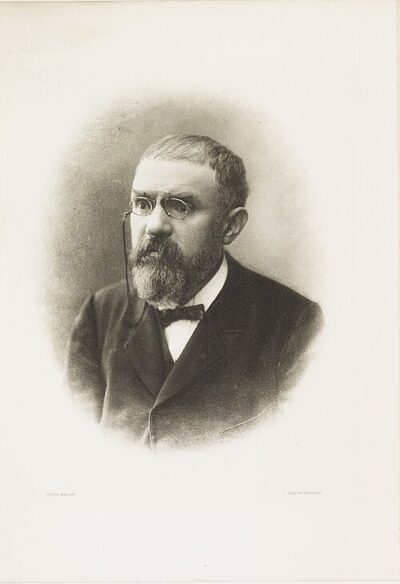
Poincaré conjecture
Poincaré conjecture is a theorem in geometric topology that every simply connected, closed 3-manifold is homeomorphic to the 3-sphere.
All 3 facts, and where they come from
Facts
3 facts · 0 confirmed by two sources · 0 cited · 3 from one source
Where this comes from
Papalocal keeps its own record. It started from these sources; what each one said is kept here as it was copied, so a change on their side never changes this page by itself. Tap one to read its version.
What Wikidata says · copied November 17, 2026 · revision 2567261040
- Described as
- theorem in geometric topology that every simply connected, closed 3-manifold is homeomorphic to the 3-sphere
- Other names
- Poincare conjecture, Poincaré theorem, Perelman’s theorem
- What it is
- theorem; conjecture (1904–)
- Named after
- Henri Poincaré
- Wikipedias with a page
- 49
Wikidata item Q203586 (wikidata.org/wiki/Q203586), public domain (CC0). Copied 2026-11-17.
What Wikipedia says · copied November 17, 2026 · revision 1383347376
In the mathematical field of geometric topology, the Poincaré conjecture (UK: , US: , French: [pwɛ̃kaʁe]) is a theorem about the characterization of the 3-sphere (the hypersphere that bounds the 4-ball in four-dimensional space).
Originally conjectured by Henri Poincaré in 1904, the theorem concerns spaces that locally look like ordinary three-dimensional Euclidean space but which are finite in extent. Poincaré hypothesized that if such a space has the additional property that each loop in the space can be continuously tightened to a point, then it is necessarily a three-dimensional sphere. Attempts to resolve the conjecture drove much progress in the field of geometric topology during the 20th century.
The eventual proof built upon Richard S. Hamilton's program of using the Ricci flow to solve the problem. By developing a number of new techniques and results in the theory of Ricci flow, Grigori Perelman modified and completed Hamilton's program. In papers posted to the arXiv repository in 2002 and 2003, Perelman presented his work proving the Poincaré conjecture (and the more powerful geometrization conjecture of William Thurston). Over the next several years, several mathematicians studied his papers and produced detailed formulations of his work.
Hamilton and Perelman's work on the conjecture is widely recognized as a milestone of mathematical research. Hamilton was recognized with the Shaw Prize in 2011 and the Leroy P. Steele Prize for Seminal Contribution to Research in 2009. The journal Science marked Perelman's proof of the Poincaré conjecture as the scientific Breakthrough of the Year in 2006. The Clay Mathematics Institute, having included the Poincaré conjecture in their well-known Millennium Prize Problem list, offered Perelman their prize of US$1 million in 2010 for the conjecture's resolution. He declined the award, saying that Hamilton's contribution had been equal to his own. As of 2026, the Poincaré conjecture is the only Millennium Prize Problem with a verified solution.
From the Wikipedia article “Poincaré conjecture” (en.wikipedia.org/wiki/Poincaré_conjecture), by its contributors, under CC BY-SA 4.0 (creativecommons.org/licenses/by-sa/4.0/). Copied 2026-11-17; not changed.
Confirmed Two sources agree. Cited One source, and it names where it got it. One source One source, without a reference of its own. Sources disagree The sources disagree. We show the best-supported value and keep theirs below.