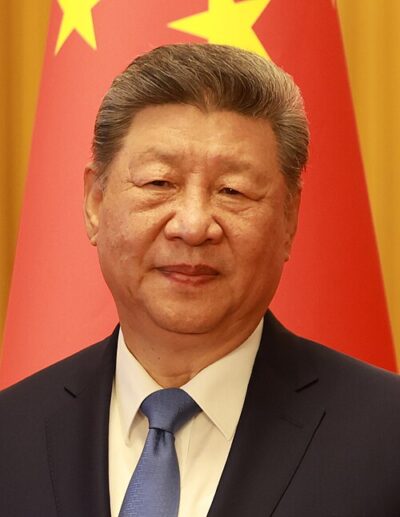
Politburo Standing Committee of the Chinese Communist Party
The Politburo Standing Committee of the Chinese Communist Party is a committee consisting of the top leadership of the Chinese Communist Party, also the top decision making body in China. It was founded in 1949. Its headquarters are in Beijing.
- Founded
- 1949
- Headquarters
- Beijing
- Country
- People's Republic of China
All 8 facts, and where they come from
Facts
8 facts · 0 confirmed by two sources · 0 cited · 8 from one source
Where this comes from
Papalocal keeps its own record. It started from these sources; what each one said is kept here as it was copied, so a change on their side never changes this page by itself. Tap one to read its version.
What Wikidata says · copied November 17, 2026 · revision 2560500737
- Described as
- committee consisting of the top leadership of the Chinese Communist Party, also the top decision making body in China
- Other names
- Standing Committee of the Political Bureau
- What it is
- political organization; state level institution; organization or unit established by the Chinese Communist Party
- Founded
- 1949 · 1 reference
- Headquarters
- Beijing · 1 reference
- Country
- People's Republic of China
- Chair
- Xi Jinping
- Part of
- Politburo of the Chinese Communist Party
- Wikipedias with a page
- 38
Wikidata item Q197542 (wikidata.org/wiki/Q197542), public domain (CC0). Copied 2026-11-17.
What Wikipedia says · copied November 17, 2026 · revision 1384635658
The Politburo Standing Committee (PSC), officially the Standing Committee of the Political Bureau of the Central Committee of the Communist Party of China, is a committee consisting of the top leadership of the Chinese Communist Party (CCP) and the state, as some of its members concurrently hold the most senior positions within the state council. Historically it has been composed of five to eleven members, and currently has seven members. Its officially mandated purpose is to conduct policy discussions and make decisions on major issues when the Politburo, a larger decision-making body, is not in session. According to the party's constitution, the general secretary of the Central Committee must also be a member of the Politburo Standing Committee.
According to the party's Constitution, the party's Central Committee elects the Politburo Standing Committee. The method by which membership is determined has evolved over time. In turn, the Politburo chooses the Politburo Standing Committee through secretive negotiations. The Standing Committee functions as the epicenter of the CCP's power and leadership, and its membership has ranged from five to eleven people. During the Mao Zedong era, Mao himself selected and expelled members, while during the Deng Xiaoping era, consultations among party elders on the Central Advisory Commission determined membership. Since the 1990s, Politburo membership has been determined through deliberations and straw polls by incumbent and retired members of both the Politburo and the Standing Committee. No woman has ever served on the PSC. The PSC is theoretically responsible to the Politburo, which is in turn responsible to the larger Central Committee. Additionally, because China is a one-party state, Standing Committee decisions must be converted into State Council or NPC regulations to acquire the force of law. Its membership is closely watched by both the national media as well as political watchers abroad. Historically, the role of the PSC has varied and evolved. During the Cultural Revolution, for example, the PSC had little power.
The membership of the PSC is strictly ranked in protocol sequence. Historically, the General Secretary (or Party Chairman) has been ranked first; the rankings of other leaders have varied over time. Since the 1990s, the General Secretary, the State President, the Premier of the State Council, first-ranked Vice Premier, the Chairman of the Standing Committee of the National People's Congress, the Chairman of the National Committee of the Chinese People's Political Consultative Conference, the Secretary of the Central Commission for Discipline Inspection, and the first-ranking member of the CCP Secretariat have consistently also been members of the Politburo Standing Committee, though their relative seniority has shifted between congresses.
From the Wikipedia article “Politburo Standing Committee of the Chinese Communist Party” (en.wikipedia.org/wiki/Politburo_Standing_Committee_of_the_Chinese_Communist_Party), by its contributors, under CC BY-SA 4.0 (creativecommons.org/licenses/by-sa/4.0/). Copied 2026-11-17; not changed.
Confirmed Two sources agree. Cited One source, and it names where it got it. One source One source, without a reference of its own. Sources disagree The sources disagree. We show the best-supported value and keep theirs below.