Politics as a Vocation
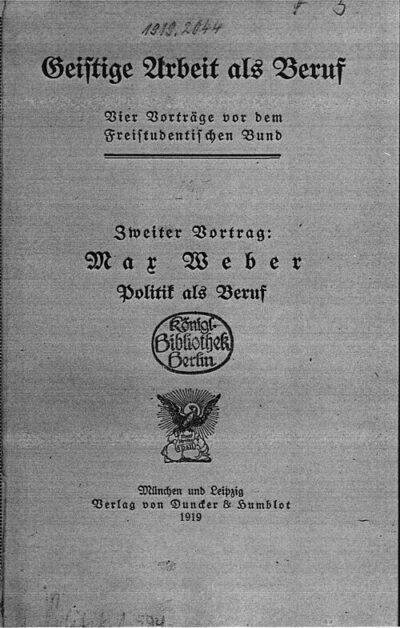
Politics as a Vocation is a non-fiction work by Max Weber. It came out in 1919.
- Published
- 1919
- Written by
- Max Weber
- Genre
- non-fiction
All 5 facts, and where they come from
Facts
5 facts · 0 confirmed by two sources · 0 cited · 5 from one source
Where this comes from
Papalocal keeps its own record. It started from these sources; what each one said is kept here as it was copied, so a change on their side never changes this page by itself. Tap one to read its version.
What Wikidata says · copied November 17, 2026 · revision 2524010337
- Described as
- non-fiction work by Max Weber
- What it is
- literary work
- Written by
- Max Weber
- Genre
- non-fiction
- Published
- 1919
- Language
- German
- Wikipedias with a page
- 15
Wikidata item Q935798 (wikidata.org/wiki/Q935798), public domain (CC0). Copied 2026-11-17.
What Wikipedia says · copied November 17, 2026 · revision 1380690589
"Politics as a Vocation" (German: Politik als Beruf) is an essay by German economist and sociologist Max Weber (1864–1920). It originated in the second lecture of a series (the first was "Science as a Vocation") he gave in Munich to the "Free (i.e. Non-incorporated) Students Union" of Bavaria on 28 January 1919. This happened during the German Revolution when Munich itself was briefly the capital of the Bavarian Soviet Republic. Weber gave the speech based on handwritten notes which were transcribed by a stenographer. The essay was published in an extended version in July 1919, and translated into English only after World War II. The essay is today regarded as a classic work of political science and sociology.
From the Wikipedia article “Politics as a Vocation” (en.wikipedia.org/wiki/Politics_as_a_Vocation), by its contributors, under CC BY-SA 4.0 (creativecommons.org/licenses/by-sa/4.0/). Copied 2026-11-17; not changed.
Confirmed Two sources agree. Cited One source, and it names where it got it. One source One source, without a reference of its own. Sources disagree The sources disagree. We show the best-supported value and keep theirs below.
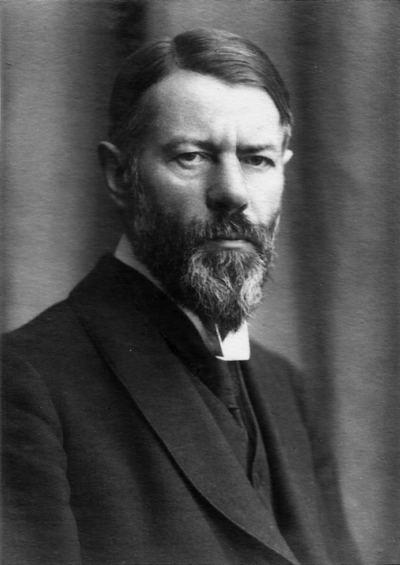
Picture: Max Weber (1864-1920), via Wikimedia Commons · Public domain