
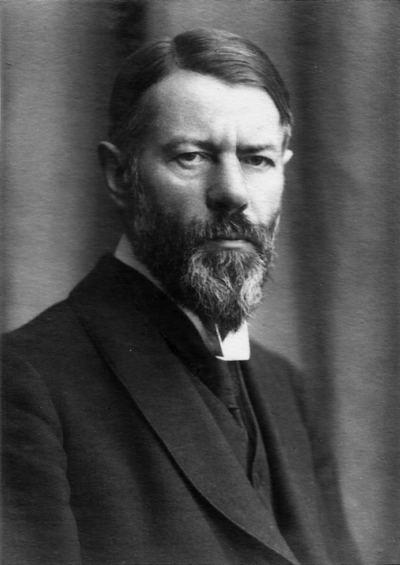
Max Weber
Max Weber was a German sociologist, philosopher, and political economist. Born April 21, 1864, in Erfurt. Died June 14, 1920, in Munich. Known for The "Objectivity" of Knowledge in Social Science and Social Policy, The Protestant Ethic and the Spirit of Capitalism and The Economic Ethics of the World Religions. Educated at Ludwig Cauer primary school and Heidelberg University.
Facts
56 facts · 2 confirmed by two sources · 31 cited · 22 from one source · 1 where the sources disagree
What’s different
- Cause of death: we show pneumonia (Sources disagree). Wikidata also lists 1918–1920 flu pandemic
Where this comes from
Papalocal keeps its own record. It started from these sources; what each one said is kept here as it was copied, so a change on their side never changes this page by itself. Tap one to read its version.
What Wikidata says · copied November 16, 2026 · revision 2568005585
- Described as
- German sociologist, philosopher, and political economist (1864–1920)
- Other names
- Maximilian Karl Emil Weber, Maximilian Carl Emil Weber, Max Vemper, Weber, Karl Emil Maximilian Weber, Carl Emil Max Weber, Maks Veber
- Born
- April 21, 1864 · 13 references
- Died
- June 14, 1920 · 14 references
- Born in
- Erfurt · 2 references
- Died in
- Munich · 3 references
- Buried in
- Bergfriedhof · 2 references
- Cause of death
- pneumonia · 1 reference; 1918–1920 flu pandemic · 1 reference
- Name at birth
- Maximilian Carl Emil Weber · 1 reference
- Citizen of
- Kingdom of Prussia · 1 reference; North German Confederation · 1 reference; German Empire · 1 reference; Weimar Republic · 1 reference
- Occupation
- jurist · 1 reference; economist; sociologist · 3 references; philosopher · 2 references; anthropologist; lawyer · 1 reference; university teacher; musicologist · 1 reference
- Political party
- National-Social Association · 1 reference; Progressive People's Party · 1 reference; German Democratic Party · 1 reference
- Worked for
- Frederick William University Berlin · 1 reference; University of Freiburg · 1 reference; Heidelberg University · 1 reference; University of Vienna · 1 reference; LMU Munich · 1 reference
- Education
- Ludwig Cauer primary school; Heidelberg University; University of Göttingen; Frederick William University Berlin; University of Strasbourg
- Member of
- Pan-German League (1893–1899) · 1 reference; German Sociological Association (1909–1912) · 2 references; Bavarian Academy of Sciences and Humanities (1919–); Heidelberg Academy of Sciences and Humanities (1909–) · 1 reference; Burschenschaft Allemannia zu Heidelberg (–1918) · 2 references
- Known for
- The "Objectivity" of Knowledge in Social Science and Social Policy; The Protestant Ethic and the Spirit of Capitalism; The Economic Ethics of the World Religions; Science as a Vocation; Politics as a Vocation; General Economic History; Economy and Society
- Field
- sociology of religion; study of history; economics; sociology · 1 reference; history · 1 reference; economy · 1 reference
- Spouse
- Marianne Weber (1893–1920) · 4 references
- Father
- Max Weber · 1 reference
- Mother
- Helene Sarah Julie Fallenstein · 1 reference
- Siblings
- Alfred Weber · 1 reference; Karl Weber · 1 reference
- Religion
- agnosticism · 2 references
- Wikipedias with a page
- 174
Wikidata item Q9387 (wikidata.org/wiki/Q9387), public domain (CC0). Copied November 16, 2026.
What Wikipedia says · copied November 16, 2026 · revision 1385782497
Maximilian Carl Emil Weber ( VAY-ber; German: [ˈveːbɐ] ; 21 April 1864 – 14 June 1920) was a German sociologist, historian, jurist, and political economist who was one of the central figures in the development of sociology and the social sciences more generally. His ideas continue to influence social theory and research.
Born in Erfurt in 1864, Weber studied law and history in Berlin, Göttingen, and Heidelberg. After earning his doctorate in law in 1889 and habilitation in 1891, he taught in Berlin, Freiburg, and Heidelberg. He married his cousin Marianne Schnitger two years later. In 1897, he had a breakdown after his father died following an argument. Weber ceased teaching and travelled until the early 1900s. He recovered and wrote The Protestant Ethic and the Spirit of Capitalism. During the First World War, he initially supported Germany's war effort but became critical of it and supported democratisation. He also gave the lectures "Science as a Vocation" and "Politics as a Vocation". After the war, Weber co-founded the German Democratic Party, unsuccessfully ran for office, and advised the drafting of the Weimar Constitution. Meanwhile, he resumed teaching in Vienna and Munich. He died of pneumonia in 1920 at the age of 56, possibly as a result of the Spanish flu. A book, Economy and Society, was left unfinished.
One of Weber's main intellectual concerns was in understanding the processes of rationalisation and disenchantment. He formulated a thesis arguing that such processes were associated with the rise of capitalism and modernity. Weber also argued that the Protestant work ethic influenced the creation of modern capitalism in The Protestant Ethic and the Spirit of Capitalism. It was followed by The Economic Ethics of the World Religions, where he examined the religions of China, India, and ancient Judaism. In terms of government, Weber argued that states were defined by their monopoly on the legitimate use of force within a given area and categorised social authority into three distinct forms: charismatic, traditional, and rational-legal. He was also a key proponent of methodological antipositivism, arguing for the study of social action through interpretive rather than purely empiricist methods. Weber made a variety of other contributions to economic sociology, political sociology, and the sociology of religion.
After his death, the rise of Weberian scholarship was slowed by the Weimar Republic's political instability and the rise of Nazi Germany. In the post-war era, organised scholarship began to appear, led by Talcott Parsons. Other American and British scholars were also involved in its development. Over the course of the twentieth century, Weber's reputation grew as translations of his works became widely available and scholars increasingly engaged with his life and ideas. As a result of these works, he began to be regarded as a founding father of sociology, alongside Karl Marx and Émile Durkheim, and one of the central figures in the development of the social sciences more generally.
- Born, in its opening lines
- April 21, 1864
- Died, in its opening lines
- June 14, 1920
From the Wikipedia article “Max Weber” (en.wikipedia.org/wiki/Max_Weber), by its contributors, under CC BY-SA 4.0 (creativecommons.org/licenses/by-sa/4.0/). Copied November 16, 2026; not changed.
Confirmed Two sources agree. Cited One source, and it names where it got it. One source One source, without a reference of its own. Sources disagree The sources disagree. We show the best-supported value and keep theirs below.
