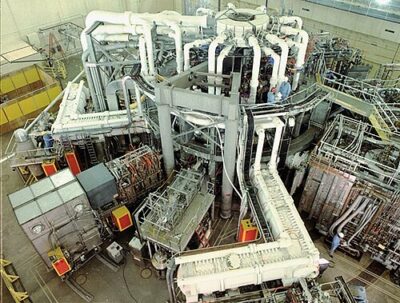
Princeton Plasma Physics Laboratory
Princeton Plasma Physics Laboratory is a national laboratory for plasma physics and nuclear fusion science at Princeton, New Jersey. It was founded in 1951 by Robert Gail Mills. Its headquarters are in Plainsboro.
- Founded
- 1951
- Founded by
- Robert Gail Mills
- Headquarters
- Plainsboro
- Country
- United States
All 12 facts, and where they come from
Facts
12 facts · 0 confirmed by two sources · 5 cited · 7 from one source
Where this comes from
Papalocal keeps its own record. It started from these sources; what each one said is kept here as it was copied, so a change on their side never changes this page by itself. Tap one to read its version.
What Wikidata says · copied November 17, 2026 · revision 2546781054
- Described as
- national laboratory for plasma physics and nuclear fusion science at Princeton, New Jersey
- Other names
- PPPL
- What it is
- research institute; United States national laboratory
- Founded
- 1951 · 1 reference
- Founded by
- Robert Gail Mills · 1 reference
- Headquarters
- Plainsboro
- Located in
- New Jersey
- Country
- United States
- Part of
- United States Department of Energy · 1 reference
- Field
- plasma physics · 1 reference; fusion power · 1 reference; microelectronics · 1 reference
- Official website
- https://www.pppl.gov/ · 1 reference
- Wikipedias with a page
- 11
Wikidata item Q1077236 (wikidata.org/wiki/Q1077236), public domain (CC0). Copied 2026-11-17.
What Wikipedia says · copied November 17, 2026 · revision 1380389553
The Princeton Plasma Physics Laboratory (PPPL) is a United States Department of Energy national laboratory for plasma physics and nuclear fusion science. Its primary mission is research into and development of fusion as an energy source. It is known for the development of the stellarator and tokamak designs, along with numerous fundamental advances in plasma physics and the exploration of many other plasma confinement concepts.
PPPL grew out of the top-secret Cold War project to control thermonuclear reactions, called Project Matterhorn. The focus of this program changed from H-bombs to fusion power in 1951, when Lyman Spitzer developed the stellarator concept and was granted funding from the Atomic Energy Commission to study the concept. This led to a series of machines in the 1950s and 1960s. In 1961, after declassification, Project Matterhorn was renamed the Princeton Plasma Physics Laboratory.
PPPL's stellarators proved unable to meet their performance goals. In 1968, Soviet claims of excellent performance on their T-3 tokamak generated brief scepticism until verified by British scientists. PPPL's Model C stellarator was quickly converted to a tokamak, and reproduced T-3's high performance. Until the 1990s, PPPL became a worldwide leader in tokamak theory and design, building a series of record-breaking machines including the Princeton Large Torus and TFTR. In 1993, TFTR was the first machine in the world to produce significant amounts of power from fusion, remaining the world record holder until 1997.
Dozens of smaller machines were also built to test particular problems and solutions, including the ATC, NSTX, and LTX. PPPL is operated by Princeton University on the Forrestal Campus in Plainsboro Township, New Jersey.
From the Wikipedia article “Princeton Plasma Physics Laboratory” (en.wikipedia.org/wiki/Princeton_Plasma_Physics_Laboratory), by its contributors, under CC BY-SA 4.0 (creativecommons.org/licenses/by-sa/4.0/). Copied 2026-11-17; not changed.
Confirmed Two sources agree. Cited One source, and it names where it got it. One source One source, without a reference of its own. Sources disagree The sources disagree. We show the best-supported value and keep theirs below.
Picture: Princeton Plasma Physics Laboratory, via Wikimedia Commons · CC BY 3.0