
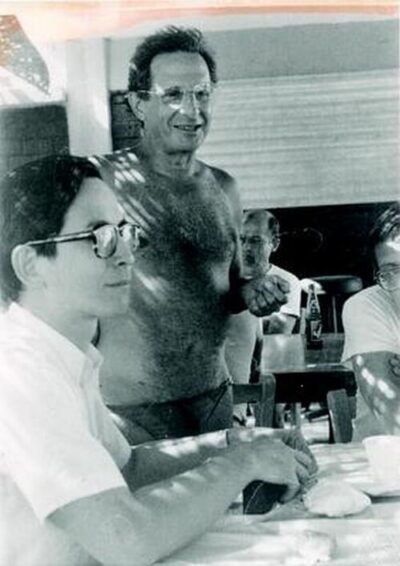
Martin David Kruskal
Martin David Kruskal was an American mathematician. Born September 28, 1925, in New York City. Died December 26, 2006, in Princeton. Known for Kruskal–Szekeres coordinates, Bernstein–Greene–Kruskal modes and Asymptotology. Educated at University of Chicago and Courant Institute School of Mathematics, Computing, and Data Science. Awards include Howard N. Potts Medal, National Medal of Science and Josiah Willard Gibbs Lectureship.
Facts
41 facts · 2 confirmed by two sources · 26 cited · 13 from one source
Where this comes from
Papalocal keeps its own record. It started from these sources; what each one said is kept here as it was copied, so a change on their side never changes this page by itself. Tap one to read its version.
What Wikidata says · copied November 16, 2026 · revision 2569116242
- Described as
- American mathematician (1925-2006)
- Other names
- Martin Kruskal, Martin D. Kruskal
- Born
- September 28, 1925 · 2 references
- Died
- December 26, 2006 · 3 references
- Born in
- New York City
- Died in
- Princeton · 1 reference
- Cause of death
- stroke
- Name at birth
- Martin David Kruskal · 1 reference
- Citizen of
- United States
- Occupation
- mathematician; physicist · 1 reference; university teacher; lecturer · 1 reference; writer · 1 reference
- Worked for
- Princeton University (1959–1989) · 1 reference; Rutgers University (1989–2006) · 2 references; Courant Institute School of Mathematics, Computing, and Data Science (1946–1951) · 1 reference; Princeton Plasma Physics Laboratory (1951–1964) · 1 reference
- Education
- University of Chicago (1942–1945) · 1 reference; Courant Institute School of Mathematics, Computing, and Data Science (1945–1948) · 1 reference; New York University (–1952) · 2 references; Riverdale Neighborhood School (–1942) · 1 reference
- Member of
- Royal Society of London (1997–) · 1 reference; National Academy of Sciences (1980–) · 1 reference; American Academy of Arts and Sciences (1983–) · 1 reference
- Known for
- Kruskal–Szekeres coordinates; Bernstein–Greene–Kruskal modes; Asymptotology
- Awards
- Howard N. Potts Medal (1986) · 1 reference; National Medal of Science (1993) · 2 references; Josiah Willard Gibbs Lectureship (1979) · 2 references; Fellow of the American Physical Society (1960) · 1 reference; Dannie Heineman Prize for Mathematical Physics (1983) · 1 reference; Foreign Member of the Royal Society (1997) · 1 reference; Steele Prize for Seminal Contribution to Research (2006) · 2 references
- Field
- theoretical physics · 1 reference; mathematical physics · 1 reference; origami · 1 reference; popular science literature · 1 reference
- Children
- Clyde Kruskal · 1 reference
- Mother
- Lillian Oppenheimer
- Siblings
- William Kruskal; Joseph Kruskal
- Wikipedias with a page
- 22
Wikidata item Q1904381 (wikidata.org/wiki/Q1904381), public domain (CC0). Copied November 16, 2026.
What Wikipedia says · copied November 16, 2026 · revision 1371971372
Martin David Kruskal (; September 28, 1925 – December 26, 2006) was an American mathematician and physicist. He made fundamental contributions in many areas of mathematics and science, ranging from plasma physics to general relativity and from nonlinear analysis to asymptotic analysis. His most celebrated contribution was in the theory of solitons.
He was a student at the University of Chicago and at New York University, where he completed his Ph.D. under Richard Courant in 1952. He spent much of his career at Princeton University, as a research scientist at the Plasma Physics Laboratory starting in 1951, and then as a professor of astronomy (1961), founder and chair of the Program in Applied and Computational Mathematics (1968), and professor of mathematics (1979). He retired from Princeton University in 1989 and joined the mathematics department of Rutgers University, holding the David Hilbert Chair of Mathematics.
Apart from serious mathematical work, Kruskal was known for mathematical diversions. For example, he invented the Kruskal count, a magical effect that has been known to perplex professional magicians because it was based not on sleight of hand but on a mathematical phenomenon.
- Born, in its opening lines
- September 28, 1925
- Died, in its opening lines
- December 26, 2006
From the Wikipedia article “Martin David Kruskal” (en.wikipedia.org/wiki/Martin_David_Kruskal), by its contributors, under CC BY-SA 4.0 (creativecommons.org/licenses/by-sa/4.0/). Copied November 16, 2026; not changed.
Confirmed Two sources agree. Cited One source, and it names where it got it. One source One source, without a reference of its own. Sources disagree The sources disagree. We show the best-supported value and keep theirs below.
