Prize Franco Abbiati Italian Music
Prize Franco Abbiati Italian Music is an Italian classical music award. It was created in 1980.
- Country
- Italy
- Created
- 1980
All 4 facts, and where they come from
Facts
4 facts · 0 confirmed by two sources · 0 cited · 4 from one source
Where this comes from
Papalocal keeps its own record. It started from these sources; what each one said is kept here as it was copied, so a change on their side never changes this page by itself. Tap one to read its version.
What Wikidata says · copied November 17, 2026 · revision 2525012044
- Described as
- Italian classical music award
- What it is
- music award
- Created
- 1980
- Country
- Italy
- Named after
- Franco Abbiati
- Wikipedias with a page
- 9
Wikidata item Q3910509 (wikidata.org/wiki/Q3910509), public domain (CC0). Copied 2026-11-17.
What Wikipedia says · copied November 17, 2026 · revision 1334851948
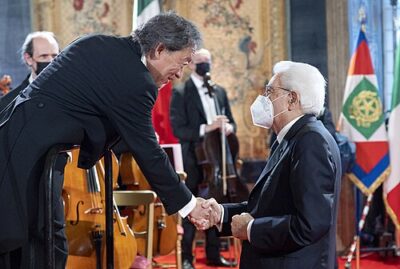
The Franco Abbiati Prize (Italian: Premio Franco Abbiati della critica musicale italiana) is an annual award that has been presented by the National Association of Music Critics in Italy since 1980. Named after the Italian musicologist Franco Abbiati, past winners of the award have included Claudio Abbado, Daniel Barenboim, Leonard Bernstein, Myung-whun Chung, Valery Gergiev, Carlo Maria Giulini, Sergiu Celibidache, John Eliot Gardiner, Leonidas Kavakos, Carlos Kleiber, Evgeny Kissin, Radu Lupu, Zubin Mehta, Arturo Benedetti Michelangeli, Seiji Ozawa, Wolfgang Sawallisch, Esa-Pekka Salonen, Pierre Boulez, Riccardo Muti, Maurizio Pollini, András Schiff, Grigory Sokolov, Jeffrey Tate, Alpesh Chauhan, Arcadi Volodos, and Krystian Zimerman, among many others.
From the Wikipedia article “Franco Abbiati Prize” (en.wikipedia.org/wiki/Franco_Abbiati_Prize), by its contributors, under CC BY-SA 4.0 (creativecommons.org/licenses/by-sa/4.0/). Copied 2026-11-17; not changed.
Confirmed Two sources agree. Cited One source, and it names where it got it. One source One source, without a reference of its own. Sources disagree The sources disagree. We show the best-supported value and keep theirs below.