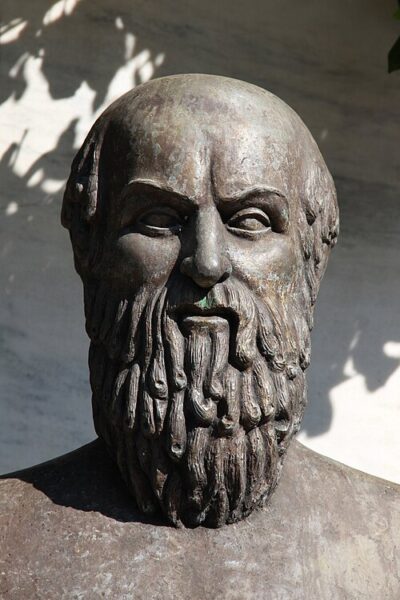
Prometheus Bound
Prometheus Bound is an ancient Greek tragedy by Aeschylus.
- Written by
- Aeschylus
- Genre
- Greek tragedy
All 4 facts, and where they come from
Facts
4 facts · 0 confirmed by two sources · 4 cited · 0 from one source
Where this comes from
Papalocal keeps its own record. It started from these sources; what each one said is kept here as it was copied, so a change on their side never changes this page by itself. Tap one to read its version.
What Wikidata says · copied November 17, 2026 · revision 2565894808
- Described as
- ancient Greek tragedy by Aeschylus
- Other names
- Prometheus in Chains, Prometheus Chained, Prometheus Chain'd, Aesch. PB
- What it is
- dramatic work · 1 reference
- Written by
- Aeschylus · 2 references
- Genre
- Greek tragedy · 1 reference
- Language
- Ancient Greek · 1 reference
- Wikipedias with a page
- 47
Wikidata item Q846870 (wikidata.org/wiki/Q846870), public domain (CC0). Copied 2026-11-17.
What Wikipedia says · copied November 17, 2026 · revision 1381509097
Prometheus Bound (Ancient Greek: Προμηθεὺς Δεσμώτης, romanized: Promētheús Desmṓtēs; Latin: Prometheus Vinctus, often abbreviated PV) is an ancient Greek tragedy traditionally attributed to Aeschylus and thought to have been composed sometime between 479 BC and the terminus ante quem of 424 BC. The tragedy is based on the myth of Prometheus, a Titan who defies Zeus, and protects and gives fire to mankind, for which he is subjected to the wrath of Zeus and punished.
British-born author, C.J. Herington, a scholar of classical Greek and Latin, wrote that Aeschylus certainly did not mean Prometheus Bound to be a "self-contained dramatic unity", and suggests that "most modern students of the subject would probably agree" that Prometheus Bound was followed by a work with the title Prometheus Lyomenos (Prometheus Unbound). Herington adds that "some very slight evidence" indicates that Prometheus Unbound "may have been followed by a third play", Prometheus Pyrphoros (Prometheus the Fire-Bearer); the latter two survive only in fragments. Some scholars have proposed that these fragments all originated from Prometheus Unbound, and that there were only two Promethean plays rather than three. Since the final two dramas of the trilogy have been lost, the author's intention for the work as a whole is not known.
The ascription to Aeschylus had never been challenged since antiquity down to relatively recent times. By the 1970s, both R. P. Winnington-Ingram and Denys Page had become sceptical of its authenticity, but the majority of scholars still affirmed the traditional attribution of authorship. Independently in 1977 both Oliver Taplin and Mark Griffith made forceful cases, on linguistic, technical and stagecraft grounds, for questioning its authenticity, a view supported by M. L. West. To date, no consensus on the matter has been established, though recent computerized stylometric analysis has thrown the burden of proof on those who uphold the traditional claim.
From the Wikipedia article “Prometheus Bound” (en.wikipedia.org/wiki/Prometheus_Bound), by its contributors, under CC BY-SA 4.0 (creativecommons.org/licenses/by-sa/4.0/). Copied 2026-11-17; not changed.
Confirmed Two sources agree. Cited One source, and it names where it got it. One source One source, without a reference of its own. Sources disagree The sources disagree. We show the best-supported value and keep theirs below.
Picture: Wikimedia Commons: Prometheus Bound, Vienna, Cod. phil. gr. 197.jpg · See Commons file page