
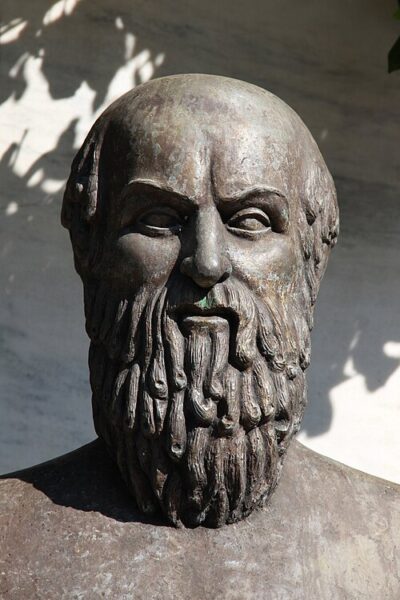
Aeschylus
Aeschylus was an ancient Athenian playwright. Born 525 BC, in Elefsina. Died 456 BC, in Gela. Known for Agamemnon, The Libation Bearers and Eumenides.
Facts
23 facts · 0 confirmed by two sources · 9 cited · 14 from one source
Where this comes from
Papalocal keeps its own record. It started from these sources; what each one said is kept here as it was copied, so a change on their side never changes this page by itself. Tap one to read its version.
What Wikidata says · copied November 16, 2026 · revision 2567600359
- Described as
- ancient Athenian playwright
- Other names
- Aeschylos, Æschylus
- Born
- 525 BC · 4 references
- Died
- 456 BC · 4 references
- Born in
- Elefsina · 2 references
- Died in
- Gela · 2 references
- Citizen of
- Classical Athens · 1 reference
- Occupation
- tragedy writer · 3 references; warrior; playwright · 3 references; writer · 3 references
- Genre
- Greek tragedy · 2 references
- Known for
- Agamemnon; The Libation Bearers; Eumenides; The Persians; Prometheus Bound · 1 reference; Seven against Thebes; Suppliants
- Children
- Euphorion; Euaeon · 1 reference
- Father
- Euphorion of Eleusis · 1 reference
- Siblings
- Aeschylus' sister; Cynaegirus; Ameinias of Athens
- Wikipedias with a page
- 154
Wikidata item Q40939 (wikidata.org/wiki/Q40939), public domain (CC0). Copied November 16, 2026.
What Wikipedia says · copied November 16, 2026 · revision 1379837439
Aeschylus (UK: , US: ; Ancient Greek: Αἰσχύλος Aischýlos; c. 525/524 – c. 456/455 BC) was an ancient Greek tragedian, often described as the father of tragedy. Academic knowledge of the genre begins with his work, and understanding of earlier Greek tragedy is largely based on inferences made from reading his surviving plays. According to Aristotle, he expanded the number of characters in the theatre and allowed conflict among them. Formerly, characters interacted only with the chorus.
Aeschylus wrote an estimated 70 to 90 plays, of which only seven have survived in complete form. There is a long-standing debate regarding the authorship of one of them, Prometheus Bound, with some scholars arguing that it may be the work of his son Euphorion. Fragments from other plays have survived in quotations, and more continue to be discovered on Egyptian papyri. These fragments often give further insights into Aeschylus's work. He was likely the first dramatist to present plays as a trilogy, with his Oresteia being the only extant ancient example. At least one of his plays was influenced by the Persians' second invasion of Greece (480–479 BC). This work, The Persians, is one of very few known classical Greek tragedies concerned with contemporary events, and the only one extant. The significance of the war with Persia was so great to Aeschylus and the Greeks that his epitaph commemorates his participation in the Greek victory at Marathon while making no mention of his success as a playwright.
From the Wikipedia article “Aeschylus” (en.wikipedia.org/wiki/Aeschylus), by its contributors, under CC BY-SA 4.0 (creativecommons.org/licenses/by-sa/4.0/). Copied November 16, 2026; not changed.
Confirmed Two sources agree. Cited One source, and it names where it got it. One source One source, without a reference of its own. Sources disagree The sources disagree. We show the best-supported value and keep theirs below.
