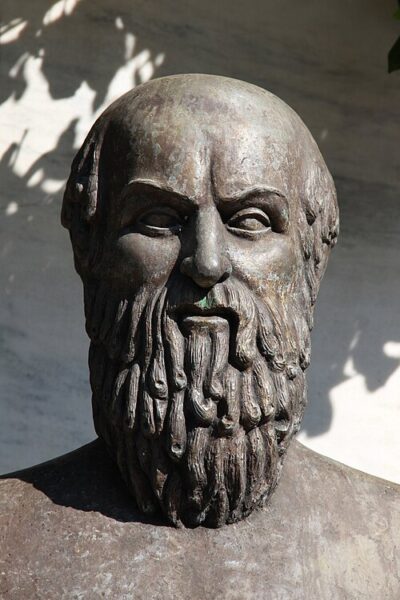
Suppliants
Suppliants is an ancient Greek tragedy by Aeschylus.
- Written by
- Aeschylus
- Genre
- Greek tragedy
All 4 facts, and where they come from
Facts
4 facts · 0 confirmed by two sources · 4 cited · 0 from one source
Where this comes from
Papalocal keeps its own record. It started from these sources; what each one said is kept here as it was copied, so a change on their side never changes this page by itself. Tap one to read its version.
What Wikidata says · copied November 17, 2026 · revision 2565887236
- Described as
- ancient Greek tragedy by Aeschylus
- Other names
- Supplices, Suppliant Women, The Suppliant Maidens, The Supplicants, Aesch. Supp., The Suppliants
- What it is
- dramatic work · 1 reference
- Written by
- Aeschylus · 1 reference
- Genre
- Greek tragedy · 1 reference
- Language
- Ancient Greek · 1 reference
- Wikipedias with a page
- 25
Wikidata item Q1216139 (wikidata.org/wiki/Q1216139), public domain (CC0). Copied 2026-11-17.
What Wikipedia says · copied November 17, 2026 · revision 1371732374
The Suppliants (Ancient Greek: Ἱκέτιδες, Hiketides; Latin: Supplices), also called The Suppliant Maidens, The Suppliant Women, or Supplices is a play by Aeschylus. It was probably first performed "only a few years previous to the Oresteia, which was brought out 458 BC." It seems to be the first play in a tetralogy, sometimes referred to as the Danaid Tetralogy, which probably included the lost plays The Egyptians (also called Aigyptioi), and The Daughters of Danaus (also called The Danaïdes or The Danaids), and the satyr play Amymone. It was long thought to be the earliest surviving play by Aeschylus due to the relatively anachronistic function of the chorus as the protagonist of the drama. However, evidence discovered in the mid-twentieth century shows it was one of Aeschylus' last plays, definitely written after The Persians and possibly after Seven Against Thebes. One reason The Suppliants was thought to be an early play was "its preponderance of choral lyric, . . . a succession of choral odes that are among the densest, most opulent, most purely lovely things in all Greek poetry."
Greek tragedies—The Suppliants and Sophocles' Philoctetes, for example—do not always end with the downfall of the protagonist. Rather, the agony of the Danaids in fleeing a forced marriage is essentially tragic. And Pelasgus is faced with the choice of protecting the suppliants, which would likely involve a war with Egypt; or rejecting their plea for protection, which would mean offending Zeus, who supports suppliants, and who might well punish him and his country in response. Furthermore, the suppliants threaten to commit suicide if their plea is rejected, which would bring ritual pollution on the city and its people and draw down the anger of Zeus upon them. The plays ends with the success of the suppliants and the deferral of any war with Egypt. But this is only a temporary reprieve, and the following plays of the tetralogy continue, probably, with a war between Argos and Egypt, followed by other tragic events and dilemmas.
From the Wikipedia article “The Suppliants (Aeschylus)” (en.wikipedia.org/wiki/The_Suppliants_(Aeschylus)), by its contributors, under CC BY-SA 4.0 (creativecommons.org/licenses/by-sa/4.0/). Copied 2026-11-17; not changed.
Confirmed Two sources agree. Cited One source, and it names where it got it. One source One source, without a reference of its own. Sources disagree The sources disagree. We show the best-supported value and keep theirs below.