Pythagorean triple
Pythagorean triple is a three positive integers, the squares of two of which sum to the square of the third.
All 4 facts, and where they come from
Facts
4 facts · 0 confirmed by two sources · 0 cited · 4 from one source
Where this comes from
Papalocal keeps its own record. It started from these sources; what each one said is kept here as it was copied, so a change on their side never changes this page by itself. Tap one to read its version.
What Wikidata says · copied November 17, 2026 · revision 2522806743
- Described as
- three positive integers, the squares of two of which sum to the square of the third
- Other names
- Pythagorean triples
- What it is
- mathematical concept
- Followed by
- Pythagorean quadruple
- Named after
- Pythagoras; Pythagorean theorem
- Wikipedias with a page
- 64
Wikidata item Q208225 (wikidata.org/wiki/Q208225), public domain (CC0). Copied 2026-11-17.
What Wikipedia says · copied November 17, 2026 · revision 1380816662
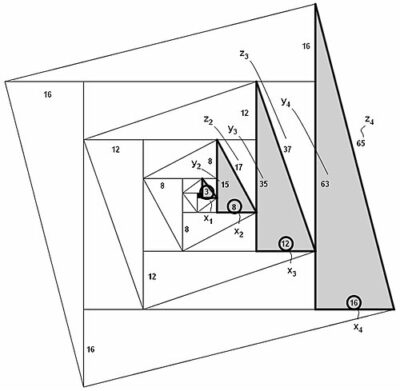
A Pythagorean triple consists of three positive integers a, b, and c, such that a2 + b2 = c2. Such a triple is commonly written (a, b, c), a well-known example is (3, 4, 5). If (a, b, c) is a Pythagorean triple, then so is (ka, kb, kc) for any positive integer k. A triangle whose side lengths are a Pythagorean triple is a right triangle and called a Pythagorean triangle.
A primitive Pythagorean triple is one in which a, b and c are coprime (that is, they have no common divisor larger than 1). For example, (3, 4, 5) is a primitive Pythagorean triple whereas (6, 8, 10) is not. Every Pythagorean triple can be scaled to a unique primitive Pythagorean triple by dividing (a, b, c) by their greatest common divisor. Conversely, every Pythagorean triple can be obtained by multiplying the elements of a primitive Pythagorean triple by a positive integer (the same for the three elements).
The name is derived from the Pythagorean theorem, stating that every right triangle has side lengths satisfying the formula a2+b2=c2; thus, Pythagorean triples describe the three integer side lengths of a right triangle. However, right triangles with non-integer sides do not form Pythagorean triples. For instance, the triangle with sides a=b=1 and c=2 is a right triangle, but (1,1,2) is not a Pythagorean triple because the square root of 2 is not an integer. Moreover, 1 and 2 do not have an integer common multiple because 2 is irrational.
Pythagorean triples have been known since ancient times. The oldest known record comes from Plimpton 322, a Babylonian clay tablet from about 1800 BC, written in a sexagesimal number system.
When searching for integer solutions, the equation a2 + b2 = c2 is a Diophantine equation. Thus Pythagorean triples are among the oldest known solutions of a nonlinear Diophantine equation.
From the Wikipedia article “Pythagorean triple” (en.wikipedia.org/wiki/Pythagorean_triple), by its contributors, under CC BY-SA 4.0 (creativecommons.org/licenses/by-sa/4.0/). Copied 2026-11-17; not changed.
Confirmed Two sources agree. Cited One source, and it names where it got it. One source One source, without a reference of its own. Sources disagree The sources disagree. We show the best-supported value and keep theirs below.
Picture: Luis Teia Gomes, via Wikimedia Commons · CC BY-SA 3.0