
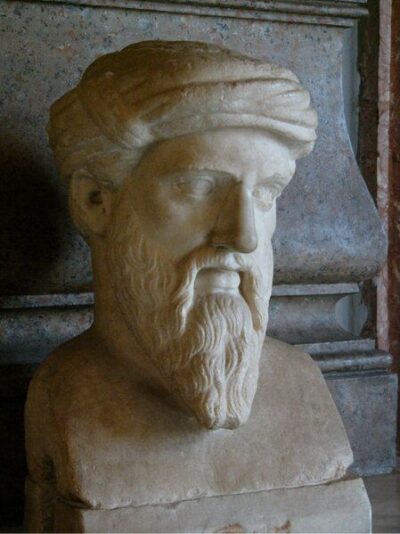
Pythagoras
Pythagoras was a Greek philosopher and mathematician (c. 570 – c. 495 BC). Born 6th century BC, in Samos. Died 490s BC, in Metapontum. Known for Pythagorean theorem, Pythagorean triple and Platonic solid.
Facts
30 facts · 0 confirmed by two sources · 8 cited · 22 from one source
Where this comes from
Papalocal keeps its own record. It started from these sources; what each one said is kept here as it was copied, so a change on their side never changes this page by itself. Tap one to read its version.
What Wikidata says · copied November 16, 2026 · revision 2567836236
- Described as
- Greek philosopher and mathematician (c. 570 – c. 495 BC)
- Other names
- Pythagoras from Samos, Samian Sage, Pythagoras of Samos
- Born
- 6th century BC · 1 reference
- Died
- 490s BC · 1 reference
- Born in
- Samos
- Died in
- Metapontum · 1 reference
- Name at birth
- Πυθαγόρας · 1 reference
- Citizen of
- Samos
- Occupation
- mathematician · 1 reference; philosopher · 2 references; politician; writer · 1 reference; musicologist; music theorist
- Known for
- Pythagorean theorem; Pythagorean triple; Platonic solid · 1 reference
- Field
- geometry; mathematics · 1 reference; ethics · 1 reference; politics · 1 reference; philosophy · 1 reference; astronomy · 1 reference
- Spouse
- Theano
- Children
- Mnesarchus · 1 reference; Myia; Damo; Telauges; Arignote
- Father
- Mnesarchus
- Religion
- Pythagoreanism
- Lived in
- Crotone
- Wikipedias with a page
- 212
Wikidata item Q10261 (wikidata.org/wiki/Q10261), public domain (CC0). Copied November 16, 2026.
What Wikipedia says · copied November 16, 2026 · revision 1379710816
Pythagoras of Samos (Ancient Greek: Πυθαγόρας; c. 570 – c. 495 BC) was an ancient Ionian Greek philosopher, polymath, and the eponymous founder of Pythagoreanism. His political and religious teachings were well known in Magna Graecia and influenced the philosophies of Plato, Aristotle, and, through them, Western philosophy. Modern scholars disagree regarding Pythagoras's education and influences, but most agree that he travelled to Croton in southern Italy around 530 BC, where he founded a school in which initiates were allegedly sworn to secrecy and lived a communal, ascetic lifestyle.
In antiquity, Pythagoras was credited with mathematical and scientific discoveries, such as the Pythagorean theorem, Pythagorean tuning, the five regular solids, the theory of proportions, the sphericity of the Earth, the identity of the morning and evening stars as the planet Venus, and the division of the globe into five climatic zones. He was reputedly the first man to call himself a philosopher ("lover of wisdom"). Historians debate whether Pythagoras made these discoveries and pronouncements, as some of the accomplishments credited to him likely originated earlier or were made by his colleagues or successors, such as Hippasus and Philolaus.
The teaching most securely identified with Pythagoras is the "transmigration of souls" or metempsychosis, which holds that every soul is immortal and, upon death, enters into a new body. He may have also devised the doctrine of musica universalis, which holds that the planets move according to mathematical ratios and thus resonate to produce an inaudible symphony of music. Following Croton's decisive victory over Sybaris in around 510 BC, Pythagoras's followers came into conflict with supporters of democracy, and their meeting houses were burned. Pythagoras may have been killed during this persecution, or he may have escaped to Metapontum and died there.
Pythagoras influenced Plato whose dialogues (especially Timaeus) exhibit Pythagorean ideas. A major revival of his teachings occurred in the first century BC among Middle Platonists, coinciding with the rise of Neopythagoreanism. Pythagoras continued to be regarded as a great philosopher throughout the Middle Ages and Pythagoreanism had an influence on scientists such as Nicolaus Copernicus, Johannes Kepler, and Isaac Newton. Pythagorean symbolism was also used throughout early modern European esotericism, and his teachings as portrayed in Ovid's Metamorphoses would later influence the modern vegetarian movement.
From the Wikipedia article “Pythagoras” (en.wikipedia.org/wiki/Pythagoras), by its contributors, under CC BY-SA 4.0 (creativecommons.org/licenses/by-sa/4.0/). Copied November 16, 2026; not changed.
Confirmed Two sources agree. Cited One source, and it names where it got it. One source One source, without a reference of its own. Sources disagree The sources disagree. We show the best-supported value and keep theirs below.
