Platonic solid
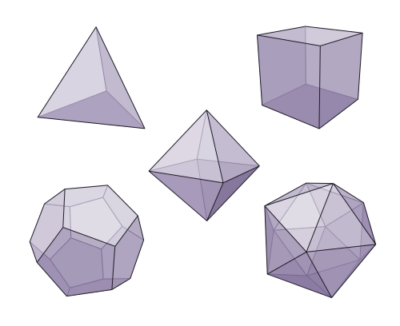
Platonic solid is a convex regular polyhedra with the same number of faces at each vertex.
All 3 facts, and where they come from
Facts
3 facts · 0 confirmed by two sources · 0 cited · 3 from one source
Where this comes from
Papalocal keeps its own record. It started from these sources; what each one said is kept here as it was copied, so a change on their side never changes this page by itself. Tap one to read its version.
What Wikidata says · copied November 17, 2026 · revision 2569927447
- Described as
- convex regular polyhedra with the same number of faces at each vertex
- Other names
- Platonic polyhedron
- What it is
- mathematical concept; type of polyhedron by properties
- Named after
- Plato
- Wikipedias with a page
- 63
Wikidata item Q188745 (wikidata.org/wiki/Q188745), public domain (CC0). Copied 2026-11-17.
What Wikipedia says · copied November 17, 2026 · revision 1384850651
In geometry, a Platonic solid is a convex, regular polyhedron in three-dimensional Euclidean space. Being a regular polyhedron means that the faces are congruent (identical in shape and size) regular polygons (all angles congruent and all edges congruent), and the same number of faces meet at each vertex. There are only five such polyhedra: the regular tetrahedron (four triangular faces), the cube (six square faces), the regular octahedron (eight triangular faces), the regular dodecahedron (twelve pentagonal faces), and the regular icosahedron (twenty triangular faces).
Geometers have studied the Platonic solids for thousands of years. They are named for the ancient Greek philosopher Plato, who hypothesized in one of his dialogues, the Timaeus, that the classical elements were made of these regular solids.
From the Wikipedia article “Platonic solid” (en.wikipedia.org/wiki/Platonic_solid), by its contributors, under CC BY-SA 4.0 (creativecommons.org/licenses/by-sa/4.0/). Copied 2026-11-17; not changed.
Confirmed Two sources agree. Cited One source, and it names where it got it. One source One source, without a reference of its own. Sources disagree The sources disagree. We show the best-supported value and keep theirs below.
Picture: Drummyfish, via Wikimedia Commons · CC0