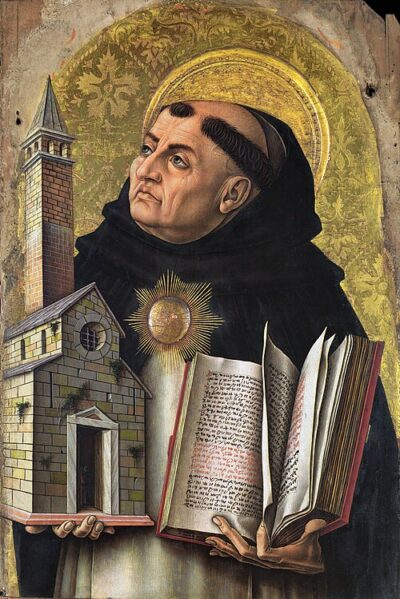
Quinque viae
Quinque viae is a 5 logical arguments for the existence of God made by Thomas Aquinas in his book Summa Theologica: the argument from motion; the argument from causation; the argument from contingency; the argument from degree; the argument from final cause.
- Created by
- Thomas Aquinas
All 1 facts, and where they come from
Facts
1 facts · 0 confirmed by two sources · 0 cited · 1 from one source
Where this comes from
Papalocal keeps its own record. It started from these sources; what each one said is kept here as it was copied, so a change on their side never changes this page by itself. Tap one to read its version.
What Wikidata says · copied November 17, 2026 · revision 2546452828
- Described as
- 5 logical arguments for the existence of God made by Thomas Aquinas in his book Summa Theologica: the argument from motion; the argument from causation; the argument from contingency; the argument from degree; the argument from final cause
- Other names
- Five Ways, Five Proofs
- Created by
- Thomas Aquinas
- Wikipedias with a page
- 19
Wikidata item Q1192931 (wikidata.org/wiki/Q1192931), public domain (CC0). Copied 2026-11-17.
What Wikipedia says · copied November 17, 2026 · revision 1379500122
The Five Ways, or Quinque viæ, are five short arguments for the existence of God, written by the medieval Christian theologian and philosopher Thomas Aquinas in the 13th century. They appear in his major work, the Summa Theologiae, where Aquinas asks whether God exists and answers yes. Each argument starts from something that people can observe in the world and reasons that it points to God as its source.
Things in the world change and move, and each change seems to be brought about by something else.
Everything that happens has a cause, and causes themselves have causes.
Things in the world exist but did not have to, so something must explain why anything exists at all.
Things can be more or less good or true, which suggests a highest standard.
Natural things, such as plants and planets, behave in regular ways that seem to aim at an end.
In each case, Aquinas argues that the chain of explanation cannot be unending and must end in a first cause, which he identifies with God.
They draw mainly on the ideas of the philosophers Aristotle and Avicenna. He did not present the Five Ways as the only way to know God, but as a way that reason alone, without relying on religious texts, could support belief in God.
The Five Ways remain influential in Catholic thought and in the philosophy of religion. Critics have questioned whether the arguments prove what Aquinas claims, particularly the idea that a chain of causes must have a first member, while defenders argue that these criticisms misread what Aquinas meant.
From the Wikipedia article “Five Ways (Aquinas)” (en.wikipedia.org/wiki/Five_Ways_(Aquinas)), by its contributors, under CC BY-SA 4.0 (creativecommons.org/licenses/by-sa/4.0/). Copied 2026-11-17; not changed.
Confirmed Two sources agree. Cited One source, and it names where it got it. One source One source, without a reference of its own. Sources disagree The sources disagree. We show the best-supported value and keep theirs below.