
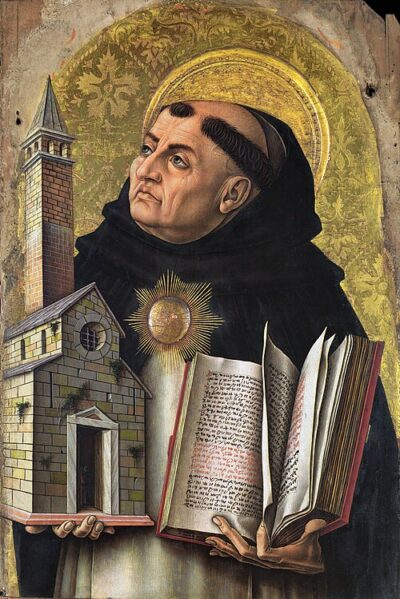
Thomas Aquinas
Thomas Aquinas was an Italian Dominican friar, philosopher, Catholic priest, and Doctor of the Church. Born 1225, in castle of the counts of Aquino. Died March 7, 1274, in Fossanova Abbey. Positions held include professor. Known for Summa Theologica, Summa contra Gentiles and De regimine principum. Educated at University of Paris and University of Naples Federico II.
Facts
38 facts · 2 confirmed by two sources · 6 cited · 30 from one source
Where this comes from
Papalocal keeps its own record. It started from these sources; what each one said is kept here as it was copied, so a change on their side never changes this page by itself. Tap one to read its version.
What Wikidata says · copied November 16, 2026 · revision 2569283434
- Described as
- Italian Dominican friar, philosopher, Catholic priest, and Doctor of the Church (1225–1274)
- Other names
- Tommaso d'Aquino, St Thomas Aquinas, Aquinas, Angelic Doctor, Dumb Ox, Saint Thomas Aquinas, Thomas of Aquino, Saint Thomas, St. Thomas Aquinas
- Born
- 1225 · 2 references
- Died
- March 7, 1274 · 2 references
- Born in
- castle of the counts of Aquino · 1 reference
- Died in
- Fossanova Abbey · 2 references
- Buried in
- Church of the Jacobins (1369–)
- Occupation
- theologian · 3 references; Latin Catholic priest; philosopher · 2 references; writer · 1 reference; Catholic theologian · 1 reference; friar; theology teacher; university teacher
- Positions held
- professor
- Worked for
- University of Paris; University of Naples Federico II
- Education
- University of Paris (1245–1248); University of Naples Federico II (1239–1245)
- Known for
- Summa Theologica; Summa contra Gentiles; De regimine principum; Quinque viae; Commentary on Aristotle's Metaphysics; Postilla super Psalmos; Quaestio disputata De anima; Super Boetium De Trinitate; Sententia super Meteora; De unitate intellectus contra averroistas
- Field
- philosophy; theology; Catholic theology; Christian theology · 1 reference
- Father
- Landulphe d'Aquino
- Mother
- Teodora Galluccio
- Siblings
- Adenolfo d'Aquino; Teodora d'Aquino
- Religion
- Catholicism
- Lived in
- Aquino
- Wikipedias with a page
- 208
Wikidata item Q9438 (wikidata.org/wiki/Q9438), public domain (CC0). Copied November 16, 2026.
What Wikipedia says · copied November 16, 2026 · revision 1385890499
Thomas Aquinas ( ə-KWY-nəs; Italian: Tommaso d'Aquino, lit. 'Thomas of Aquino'; c. 1225 – 7 March 1274) was an Italian Dominican friar and priest, theologian, and philosopher. He is considered one of the most influential thinkers in the history of Catholic theology and Western philosophy. He is the father of a school of thought (encompassing both theology and philosophy) known as Thomism.
A proponent of natural theology, Thomas argued that God is the source of the light of natural reason and the light of faith. He embraced several ideas put forward by Aristotle and sought to synthesize Aristotelian philosophy with the principles of Christianity. Among his best-known ideas include his Five Ways for proving the existence of God, his virtue ethics, and his sacramental theology. In addition to its vast influence on Catholic thought, his philosophy has influenced modern virtue ethics, aesthetics, and cognitive theory.
Thomas's best-known work is the unfinished Summa Theologica, or Summa Theologiae (1265–1274), which is a comprehensive guide to the theology of the Catholic Church. His body of work also includes the Disputed Questions on Truth (1256–1259), the Summa contra Gentiles (1259–1265), and numerous commentaries on Christian Scripture and on Aristotle. He is also known for his Eucharistic hymns, which form a part of the Church's liturgy. In 1323, nearly 50 years after his death, Thomas was canonized as a saint by Pope John XXII.
Thomas has been described as "the most influential thinker of the medieval period" and is generally considered to be one of the Catholic Church's greatest theologians and philosophers. As one of the 38 Doctors of the Church, he is known by multiple titles, including Doctor Angelicus ("Angelic Doctor"), Doctor Communis ("Universal Doctor"), and Doctor Humanitatis ("Doctor of Humanity").
- Born, in its opening lines
- c. 1225
- Died, in its opening lines
- March 7, 1274
From the Wikipedia article “Thomas Aquinas” (en.wikipedia.org/wiki/Thomas_Aquinas), by its contributors, under CC BY-SA 4.0 (creativecommons.org/licenses/by-sa/4.0/). Copied November 16, 2026; not changed.
Confirmed Two sources agree. Cited One source, and it names where it got it. One source One source, without a reference of its own. Sources disagree The sources disagree. We show the best-supported value and keep theirs below.
