Radiation Laboratory
Radiation Laboratory is a World War II radar research organization at the Massachusetts Institute of Technology. It was founded in 1940.
- Founded
- October 1940
- Country
- United States
All 7 facts, and where they come from
Facts
7 facts · 0 confirmed by two sources · 3 cited · 4 from one source
Where this comes from
Papalocal keeps its own record. It started from these sources; what each one said is kept here as it was copied, so a change on their side never changes this page by itself. Tap one to read its version.
What Wikidata says · copied November 17, 2026 · revision 2548209559
- Described as
- World War II radar research organization at the Massachusetts Institute of Technology
- Other names
- Rad Lab
- What it is
- research center
- Founded
- October 1940 · 1 reference
- Ended
- December 31, 1945 · 1 reference
- Country
- United States · 1 reference
- Part of
- Massachusetts Institute of Technology; National Defense Research Committee
- Field
- radar · 1 reference
- Wikipedias with a page
- 9
Wikidata item Q4354699 (wikidata.org/wiki/Q4354699), public domain (CC0). Copied 2026-11-17.
What Wikipedia says · copied November 17, 2026 · revision 1384116668
The Radiation Laboratory (commonly called the Rad Lab) was a radar research program operating at the Massachusetts Institute of Technology (MIT) during World War II. From 1940 to 1945, the Rad Lab applied new microwave technologies to develop compact radar sets for military navigation and combat. It grew from thirty staff to nearly 4,000 at its peak, with scientific staffing comparable to the Manhattan Project's Los Alamos facility. As the largest contractor of the United States' Office of Scientific Research and Development (OSRD), the lab became a prototype for federally funded university research.
The lab was established in October 1940 after an exchange of Allied military secrets revealed the cavity magnetron, a new microwave power source, to the United States. Equipment designed by the Rad Lab accounted for nearly half of American wartime spending on radar, or approximately $1.35 billion (equivalent to $19.0 billion in 2025). These systems included the SCR-584 gun-laying radar that intercepted V-1 flying bombs over Britain; the airborne H2X radar that enabled American strategic bombing through clouds; and LORAN, a long-range radio navigation system used globally by air and maritime vessels after the war. Expanding beyond its original program of basic research, the Rad Lab engaged in systems engineering, "crash" manufacturing of experimental equipment, and field support in combat theaters. Most lab-designed systems were built by industrial contractors.
Lee DuBridge directed the laboratory, with Isidor Rabi overseeing research operations. It drew physicists and other researchers from sixty-nine universities and received $106.8 million (equivalent to $1.51 billion in 2025) in government contracts, dwarfing MIT's own academic budget and comprising 23 percent of all OSRD research spending. A civilian operation, the lab used facilities of MIT and both military branches, and maintained close ties with its British military counterpart, the Telecommunications Research Establishment.
When it closed in December 1945, its functions were dispersed to industry and to new units within MIT. Two interdepartmental MIT laboratories continued the basic science program of the Rad Lab, and in 1951, the Lincoln Laboratory was formed to further develop radar-based air defense systems. The 28-volume MIT Radiation Laboratory Series compiled and declassified the lab's discoveries, becoming a standard reference in postwar electronics development. Ten laboratory members later won Nobel Prizes, its alumni and inventions helped establish Boston's Route 128 high-technology corridor, and the model of civilian-military research collaboration had a lasting influence on postwar American science.
From the Wikipedia article “MIT Radiation Laboratory” (en.wikipedia.org/wiki/MIT_Radiation_Laboratory), by its contributors, under CC BY-SA 4.0 (creativecommons.org/licenses/by-sa/4.0/). Copied 2026-11-17; not changed.
Confirmed Two sources agree. Cited One source, and it names where it got it. One source One source, without a reference of its own. Sources disagree The sources disagree. We show the best-supported value and keep theirs below.
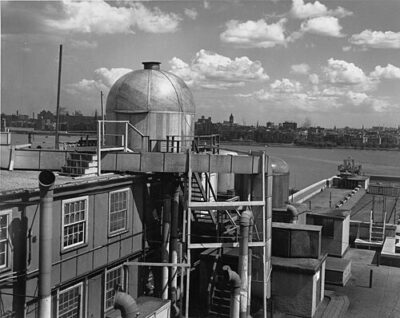
Picture: Unknown author, via Wikimedia Commons · Public domain