Raman scattering
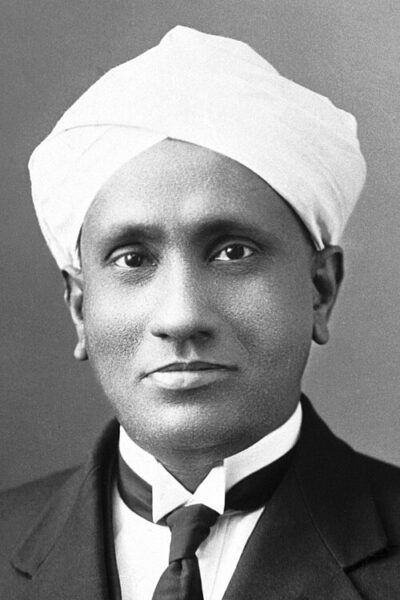
Raman scattering is a theory by India's Nobel laureate and Bharat Ratna awardee C.V. Raman.
All 2 facts, and where they come from
Facts
2 facts · 0 confirmed by two sources · 0 cited · 2 from one source
Where this comes from
Papalocal keeps its own record. It started from these sources; what each one said is kept here as it was copied, so a change on their side never changes this page by itself. Tap one to read its version.
What Wikidata says · copied November 17, 2026 · revision 2567656796
- Described as
- theory by India's Nobel laureate and Bharat Ratna awardee C.V. Raman
- Other names
- Raman effect
- What it is
- effect
- Named after
- Chandrasekhara Venkata Raman
- Wikipedias with a page
- 47
Wikidata item Q466824 (wikidata.org/wiki/Q466824), public domain (CC0). Copied 2026-11-17.
What Wikipedia says · copied November 17, 2026 · revision 1384610743
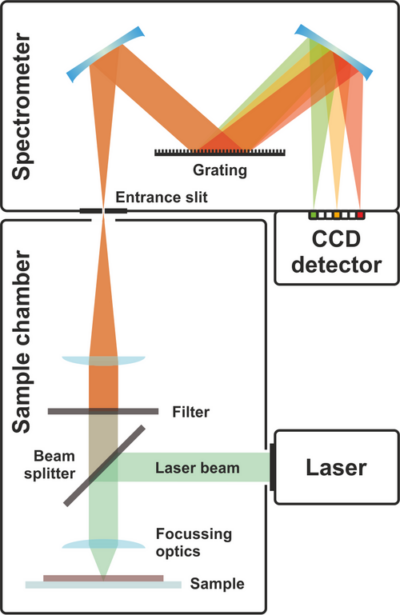
In chemistry and physics, Raman scattering or the Raman effect () is the inelastic scattering of photons by matter, meaning that there is both an exchange of energy (change of light frequency) and a change in the light's direction (momentum). Typically this effect involves vibrational energy being gained by a molecule as incident photons from a visible laser are shifted to lower energy. This is called normal Stokes-Raman scattering.
Light has a certain probability of being scattered by a material. When photons are scattered, most of them are elastically scattered (Rayleigh scattering), such that the scattered photons have the same energy (frequency, wavelength, and therefore color) as the incident photons, but different direction. Rayleigh scattering usually has an intensity in the range 0.1% to 0.01% relative to that of a radiation source. An even smaller fraction of the scattered photons (about 1 in a million) can be scattered inelastically, with the scattered photons having an energy different (usually lower) from those of the incident photons—these are Raman scattered photons. Because of conservation of energy, the material either gains or loses energy in the process.
The effect is exploited by chemists and physicists to gain information about materials for a variety of purposes by performing various forms of Raman spectroscopy. Many other variants of Raman spectroscopy allow rotational energy to be examined, if gas samples are used, and electronic energy levels may be examined if an X-ray source is used, in addition to other possibilities. More complex techniques involving pulsed lasers, multiple laser beams and so on are known.
The Raman effect is named after Indian scientist C. V. Raman, who discovered it in 1928 with assistance from his student K. S. Krishnan. Raman was awarded the 1930 Nobel Prize in Physics for his discovery of Raman scattering.
From the Wikipedia article “Raman scattering” (en.wikipedia.org/wiki/Raman_scattering), by its contributors, under CC BY-SA 4.0 (creativecommons.org/licenses/by-sa/4.0/). Copied 2026-11-17; not changed.
Confirmed Two sources agree. Cited One source, and it names where it got it. One source One source, without a reference of its own. Sources disagree The sources disagree. We show the best-supported value and keep theirs below.
Picture: Toommm, via Wikimedia Commons · CC BY 4.0