
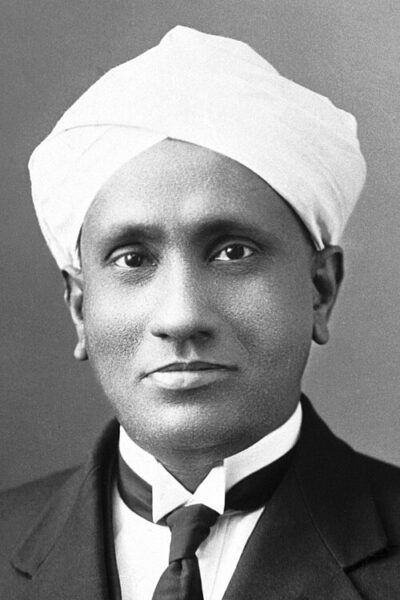
Chandrasekhara Venkata Raman
Chandrasekhara Venkata Raman was an Indian physicist. Born November 7, 1888, in Tiruchirappalli. Died November 21, 1970, in Bengaluru. Known for A New Type of Secondary Radiation and Raman scattering. Educated at University of Madras and Presidency College. Awards include Nobel Prize in Physics, Lenin Peace Prize and Bharat Ratna.
Facts
53 facts · 2 confirmed by two sources · 23 cited · 28 from one source
Where this comes from
Papalocal keeps its own record. It started from these sources; what each one said is kept here as it was copied, so a change on their side never changes this page by itself. Tap one to read its version.
What Wikidata says · copied November 16, 2026 · revision 2568763478
- Described as
- Indian physicist (1888–1970)
- Other names
- Sir Chandrasekhara Raman, C.V. Raman, Sir Chandrasekhara Venkata Raman, C. V. Raman, CV Raman, Raman, C V Raman, Sir CV Raman, Sir C.V. Raman, Sir C V Raman, Sir C. V. Raman
- Born
- November 7, 1888 · 11 references
- Died
- November 21, 1970 · 9 references
- Born in
- Tiruchirappalli · 1 reference
- Died in
- Bengaluru · 1 reference
- Citizen of
- British Raj (–1947); India (1950–); Dominion of India (1947–1950)
- Occupation
- physicist · 1 reference; university teacher; crystallographer
- Worked for
- Banaras Hindu University; Indian Institute of Science, Bengaluru; University of Calcutta
- Education
- University of Madras; Presidency College; University of Calcutta · 1 reference
- Member of
- Royal Society of London; Academy of Sciences of the USSR; Pontifical Academy of Sciences (1961–) · 1 reference; Hungarian Academy of Sciences (1937–) · 1 reference; Russian Academy of Sciences (1947–) · 1 reference; Indian National Science Academy; Romanian Academy
- Known for
- A New Type of Secondary Radiation; Raman scattering
- Awards
- Nobel Prize in Physics (1930) · 2 references; Lenin Peace Prize (1957); Bharat Ratna (1954); Fellow of the Royal Society; Hughes Medal (1930); Matteucci Medal (1928); Franklin Medal (1941); honorary doctor of the University of Calcutta; Knight Bachelor; Honorary Fellow of the Royal Society Te Apārangi (1956–) · 1 reference; honorary doctor of the University of Bordeaux (1948) · 2 references; doctor honoris causa from the University of Paris (1932) · 1 reference
- Field
- physics
- Spouse
- Lokasundari Ammal · 1 reference; Lokasundari Raman · 1 reference
- Children
- Venkatraman Radhakrishnan · 1 reference; Chandrasekhar (Raja) Raman · 1 reference
- Father
- R. Chandrasekhara Iyer · 1 reference
- Mother
- Parvathi Ammal · 1 reference
- Siblings
- CS Ayyar · 1 reference; Mangalam · 1 reference; Kumaraswamy (Skandan) · 1 reference; Sundaram · 1 reference; Sitalaxmi · 1 reference; Meena · 1 reference; Ramaswamy · 1 reference
- Religion
- Hinduism
- Lived in
- New Delhi · 1 reference
- Wikipedias with a page
- 117
Wikidata item Q60429 (wikidata.org/wiki/Q60429), public domain (CC0). Copied November 16, 2026.
What Wikipedia says · copied November 16, 2026 · revision 1384247835
Chandrasekhara Venkata Raman ( RAH-muhn; IAST: Candraśēkhara Veṅkaṭarāmaṉ; 7 November 1888 – 21 November 1970) was an Indian physicist known for his work in the field of light scattering. Using a spectrograph that he developed, he and his student K. S. Krishnan discovered that when light traverses a transparent material, the deflected light changes its wavelength. This phenomenon, a hitherto unknown type of scattering of light they called modified scattering, was subsequently termed the Raman effect or Raman scattering. In 1930, Raman received the Nobel Prize in Physics "for his work on the scattering of light and for the discovery of the effect named after him" and became the first Asian and non-White person to receive a Nobel Prize in Physics.
Born in the Indian state of Tamil Nadu, Raman was a precocious child, completing his secondary and higher secondary education from St Aloysius' Anglo-Indian High School at the ages of 11 and 13, respectively. He topped the bachelor's degree examination of the University of Madras with honours in physics from Presidency College at age 16. His first research paper, on diffraction of light, was published in 1906, while he was a graduate student. The next year he obtained a master's degree. He joined the Indian Finance Service in Calcutta as Assistant Accountant General at age 19. There he became acquainted with the Indian Association for the Cultivation of Science (IACS), the first research institute in India, which allowed him to carry out independent research and where he made his major contributions in acoustics and optics.
In 1917, he was appointed the first Palit Professor of Physics by Ashutosh Mukherjee at the Rajabazar Science College under the University of Calcutta. On his first trip to Europe, seeing the Mediterranean Sea motivated him to identify the prevailing explanation for the blue colour of the sea at the time, namely the reflected Rayleigh-scattered light from the sky, as incorrect. He founded the Indian Journal of Physics in 1926. He moved to Bengaluru in 1933 to become the first Indian director of the Indian Institute of Science. He founded the Indian Academy of Sciences that year. In 1948, he established the Raman Research Institute, where he worked to his last days. He was the uncle of Nobel laureate Subrahmanyan Chandrasekhar.
The Raman effect was discovered on 28 February 1928. The day is celebrated annually by the Government of India as the National Science Day.
- Born, in its opening lines
- November 7, 1888
- Died, in its opening lines
- November 21, 1970
From the Wikipedia article “C. V. Raman” (en.wikipedia.org/wiki/C._V._Raman), by its contributors, under CC BY-SA 4.0 (creativecommons.org/licenses/by-sa/4.0/). Copied November 16, 2026; not changed.
Confirmed Two sources agree. Cited One source, and it names where it got it. One source One source, without a reference of its own. Sources disagree The sources disagree. We show the best-supported value and keep theirs below.
