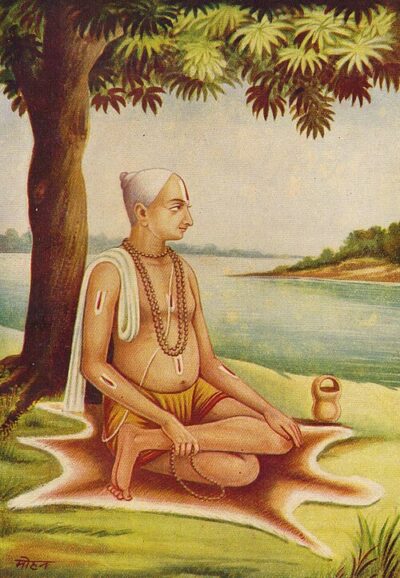
Ramcharitmanas
Ramcharitmanas is an Awadhi poem about Rama by Tulsidas.
- Published
- 16th century
- Written by
- Tulsidas
- Genre
- epic poem
All 5 facts, and where they come from
Facts
5 facts · 0 confirmed by two sources · 0 cited · 5 from one source
Where this comes from
Papalocal keeps its own record. It started from these sources; what each one said is kept here as it was copied, so a change on their side never changes this page by itself. Tap one to read its version.
What Wikidata says · copied November 17, 2026 · revision 2563301095
- Described as
- Awadhi poem about Rama by Tulsidas
- What it is
- literary work
- Written by
- Tulsidas
- Genre
- epic poem
- Published
- 16th century
- Language
- Awadhi
- Wikipedias with a page
- 32
Wikidata item Q2724561 (wikidata.org/wiki/Q2724561), public domain (CC0). Copied 2026-11-17.
What Wikipedia says · copied November 17, 2026 · revision 1385204073
Ramcharitmanas (Devanagari: रामचरितमानस rāmacaritamānasa), is an epic poem in the Awadhi language, composed by the 16th-century Indian bhakti poet Tulsidas (c. 1511–1623). It has many inspirations, the primary being the Ramayana of Valmiki.
This work is also called, in popular parlance, Tulsi Ramayana, Tulsikrit Ramayana, Tulsidas Ramayana or simply Manas. The word Ramcharitmanas literally means "Lake of the deeds of Rama". It is considered one of the greatest works of Hindu literature. The work has variously been acclaimed as "the living sum of Indian culture", "the tallest tree in the magic garden of medieval Indian poetry", "the greatest book of all devotional literature" and "the best and most trustworthy guide to the popular living faith of the Indian people".Tulsidas was a great scholar of Sanskrit, but due to limited accessibility of the language, he chose to write it in the vernacular, Awadhi, making his work more accessible to the general public. Tradition has it that Tulsidas had to face much criticism from the Sanskrit scholars of Varanasi for being a vernacular poet. However, Tulsidas remained steadfast in his resolve to simplify the knowledge contained in the Vedas, the Upanishads and the Puranas to the common people. Subsequently, his work was widely accepted.
Ramcharitmanas made available the story of Rama to the common man to sing, meditate and perform on. The writing of Ramcharitmanas also heralded many a cultural tradition, most significantly that of the tradition of Ramlila, the dramatic enactment of the text. Ramcharitmanas is considered by many as a work belonging to the Saguna school of the Bhakti movement in Hindi literature.
In May 2024, during the tenth meeting of the Memory of the World Committee for Asia and the Pacific, the Ramcharitamanas manuscripts were added to UNESCO's Memory of the World Asia-Pacific Regional Register. One manuscript was authored by Tulsidas, and the other was written in Arabic in the 18th century, showcasing the text's appeal in West Asia and other parts of the world.
From the Wikipedia article “Ramcharitmanas” (en.wikipedia.org/wiki/Ramcharitmanas), by its contributors, under CC BY-SA 4.0 (creativecommons.org/licenses/by-sa/4.0/). Copied 2026-11-17; not changed.
Confirmed Two sources agree. Cited One source, and it names where it got it. One source One source, without a reference of its own. Sources disagree The sources disagree. We show the best-supported value and keep theirs below.