
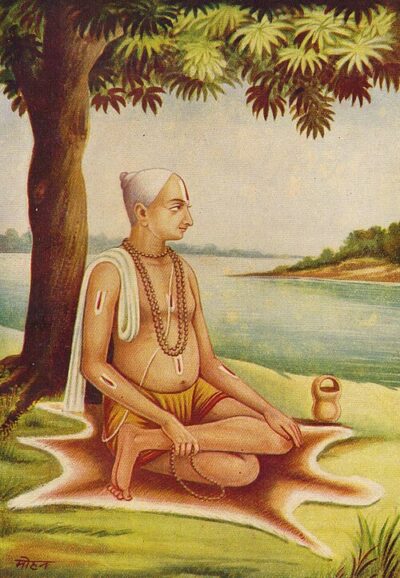
Tulsidas
Tulsidas was a Hindu saint and poet (1532–1623), author of the Ramcharitmanas and Hanuman Chalisa. Born 1532, in Rajapur. Died 1623, in Assi Ghat. Known for Ramcharitmanas and Hanuman Chalisha.
Facts
14 facts · 0 confirmed by two sources · 1 cited · 11 from one source · 2 where the sources disagree
What’s different
- Born: we show 1532 (Sources disagree). Wikidata also lists 1511
- Name at birth: we show गोस्वामी तुलसीदास (Sources disagree). Wikidata also lists रामबोला
Where this comes from
Papalocal keeps its own record. It started from these sources; what each one said is kept here as it was copied, so a change on their side never changes this page by itself. Tap one to read its version.
What Wikidata says · copied November 16, 2026 · revision 2562329467
- Described as
- Hindu saint and poet (1532–1623), author of the Ramcharitmanas and Hanuman Chalisa
- Other names
- Gosvami Tulsidas
- Born
- 1532 · 15 references; 1511
- Died
- 1623 · 16 references
- Born in
- Rajapur
- Died in
- Assi Ghat
- Name at birth
- गोस्वामी तुलसीदास; रामबोला
- Occupation
- poet; philosopher; writer
- Known for
- Ramcharitmanas; Hanuman Chalisha
- Field
- Sanskrit literature · 1 reference; Braj Bhasha literature · 1 reference
- Religion
- Vaishnavism; bhakti
- Wikipedias with a page
- 75
Wikidata item Q312976 (wikidata.org/wiki/Q312976), public domain (CC0). Copied November 16, 2026.
What Wikipedia says · copied November 16, 2026 · revision 1384767429
Rambola Dubey (c. 1532 – c. 1623), popularly known as Goswami Tulsīdās, was a Ramanandi Vaishnava Hindu saint, devotee, and poet renowned for his devotion to the deities Rama, Sita, and Hanuman. He wrote several popular works in Sanskrit, Awadhi, and Braj Bhasha, but is best known as the author of the Hanuman Chalisa and of the epic Ramcharitmanas, a retelling of the Sanskrit Ramayana, based on Rama's life, in the vernacular Awadhi language.
Tulsidas spent most of his life in the cities of Banaras (modern Varanasi) and Ayodhya. The Tulsi Ghat on the Ganges in Varanasi is named after him. He founded the Sankat Mochan Hanuman Temple in Varanasi, believed to stand at the place where he had the sight of the deity. Tulsidas started the Ramlila plays, a folk-theatre adaptation of the Ramayana.
He has been acclaimed as one of the greatest poets in Hindi, Indian, and world literature. The impact of Tulsidas and his works on the art, culture and society in India is widespread and is seen today in the vernacular language, Ramlila plays, Hindustani classical music, popular music, and television series.
From the Wikipedia article “Tulsidas” (en.wikipedia.org/wiki/Tulsidas), by its contributors, under CC BY-SA 4.0 (creativecommons.org/licenses/by-sa/4.0/). Copied November 16, 2026; not changed.
Confirmed Two sources agree. Cited One source, and it names where it got it. One source One source, without a reference of its own. Sources disagree The sources disagree. We show the best-supported value and keep theirs below.
