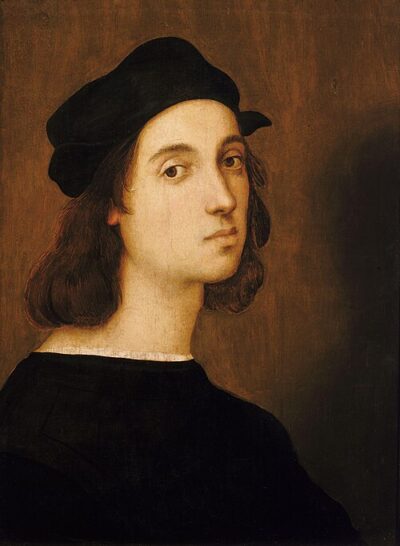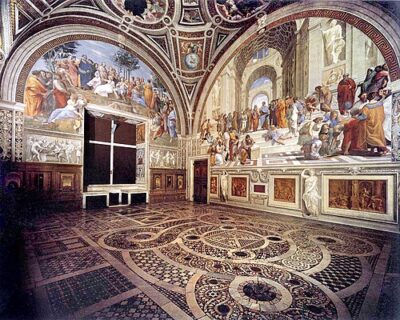
Raphael Rooms
Raphael Rooms is a suite of reception rooms in the Palace of the Vatican painted by Raphael and his workshop between 1509 and 1524. It came out in 1508.
- Came out
- 1508
- Created by
- Raphael
- Genre
- religious painting
All 8 facts, and where they come from
Facts
8 facts · 0 confirmed by two sources · 0 cited · 8 from one source
Where this comes from
Papalocal keeps its own record. It started from these sources; what each one said is kept here as it was copied, so a change on their side never changes this page by itself. Tap one to read its version.
What Wikidata says · copied November 17, 2026 · revision 2426640779
- Described as
- suite of reception rooms in the Palace of the Vatican painted by Raphael and his workshop between 1509 and 1524
- Other names
- Stanze di Raffaello
- What it is
- cycle of frescoes; building component; group
- Created by
- Raphael
- Genre
- religious painting
- Came out
- 1508
- Located in
- Vatican City
- Country
- Vatican City
- Wikipedias with a page
- 34
Wikidata item Q249449 (wikidata.org/wiki/Q249449), public domain (CC0). Copied 2026-11-17.
What Wikipedia says · copied November 17, 2026 · revision 1383585607
The four Raphael Rooms (Italian: Stanze di Raffaello) form a suite of reception rooms in the Apostolic Palace, now part of the Vatican Museums, in Vatican City. They are famous for their frescoes, painted by Raphael and his workshop. Together with Michelangelo's Sistine Chapel ceiling frescoes, they are the grand fresco sequences that mark the High Renaissance in Rome.
The Stanze, as they are commonly called, were originally intended as a suite of apartments for Pope Julius II. He commissioned Raphael, then a relatively young artist from Urbino, and his studio in 1508 or 1509 to redecorate the existing interiors of the rooms entirely. It was possibly Julius' intent to outshine the apartments of his predecessor (and rival) Pope Alexander VI, as the Stanze are directly above Alexander's Borgia Apartment. They are on the second floor, overlooking the south side of the Belvedere Courtyard.
Running from east to west, as a visitor would have entered the apartment, but not following the sequence in which the Stanze were frescoed, the rooms are the Sala di Costantino ("Hall of Constantine"), the Stanza di Eliodoro ("Room of Heliodorus"), the Stanza della Segnatura ("Room of the Signatura"), and the Stanza dell'Incendio del Borgo ("The Room of the Fire in the Borgo").
After the death of Julius in 1513, with two rooms frescoed, Pope Leo X continued the program. Following Raphael's death in 1520, his assistants Gianfrancesco Penni, Giulio Romano and Raffaellino del Colle finished the project with the frescoes in the Sala di Costantino.
From the Wikipedia article “Raphael Rooms” (en.wikipedia.org/wiki/Raphael_Rooms), by its contributors, under CC BY-SA 4.0 (creativecommons.org/licenses/by-sa/4.0/). Copied 2026-11-17; not changed.
Confirmed Two sources agree. Cited One source, and it names where it got it. One source One source, without a reference of its own. Sources disagree The sources disagree. We show the best-supported value and keep theirs below.
Picture: Lure, via Wikimedia Commons · Public domain