Requiem
Requiem is a mass composed by Wolfgang Amadeus Mozart in Vienna in 1791. It came out in 1792.
- Released
- 1792
- Came out
- 1791
All 6 facts, and where they come from
Facts
6 facts · 0 confirmed by two sources · 0 cited · 6 from one source
Where this comes from
Papalocal keeps its own record. It started from these sources; what each one said is kept here as it was copied, so a change on their side never changes this page by itself. Tap one to read its version.
What Wikidata says · copied November 17, 2026 · revision 2568922841
- Described as
- mass composed by Wolfgang Amadeus Mozart in Vienna in 1791
- Other names
- K. 626, Requiem Mass in D minor, Mozart's Requiem
- What it is
- musical work/composition
- Music by
- Wolfgang Amadeus Mozart; Franz Xaver Süssmayr
- Released
- 1792
- Language
- Latin
- Came out
- 1791
- Wikipedias with a page
- 51
Wikidata item Q207875 (wikidata.org/wiki/Q207875), public domain (CC0). Copied 2026-11-17.
What Wikipedia says · copied November 17, 2026 · revision 1383208626
The Requiem in D minor, K. 626, is a Requiem Mass by Wolfgang Amadeus Mozart. Mozart composed part of the Requiem in Vienna in late 1791, but it was unfinished at his death on 5 December the same year. A completed version was delivered to Count Franz von Walsegg, who had commissioned the piece for a requiem service on 14 February 1792 to commemorate the first anniversary of the death of his wife Anna, who had died at the age of 20 on 14 February 1791.
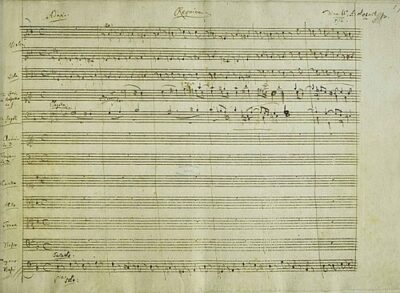
The autograph manuscript shows the finished and orchestrated movement of the Introit in Mozart's hand, and detailed drafts of the Kyrie, the Sequence (the latter including the first eight bars of the Lacrimosa), and the Offertorium. First Joseph Eybler and then Franz Xaver Süssmayr filled in the rest, composed additional movements, and made a clean copy of the completed parts of the score for delivery to Walsegg, imitating Mozart's musical handwriting but clumsily dating it "1792." It cannot be shown to what extent Süssmayr may have depended on now lost "scraps of paper" for the remainder; he later claimed the Sanctus and Benedictus and the Agnus Dei as his own.
Walsegg probably intended to pass the Requiem off as his own composition, as he is known to have done with other works. This plan was frustrated by a public benefit performance for Mozart's widow Constanze. She was responsible for a number of stories surrounding the composition of the work, including the claims that Mozart received the commission from a mysterious messenger who did not reveal the commissioner's identity, and that Mozart came to believe that he was writing the Requiem for his own funeral.
In addition to the Süssmayr version, a number of alternative completions have been developed by composers and musicologists in the 20th and 21st centuries. At least 19 conjectural completions have been made, eleven of which date from after 2005.
From the Wikipedia article “Requiem (Mozart)” (en.wikipedia.org/wiki/Requiem_(Mozart)), by its contributors, under CC BY-SA 4.0 (creativecommons.org/licenses/by-sa/4.0/). Copied 2026-11-17; not changed.
Confirmed Two sources agree. Cited One source, and it names where it got it. One source One source, without a reference of its own. Sources disagree The sources disagree. We show the best-supported value and keep theirs below.
Picture: Wikimedia Commons · Public domain