
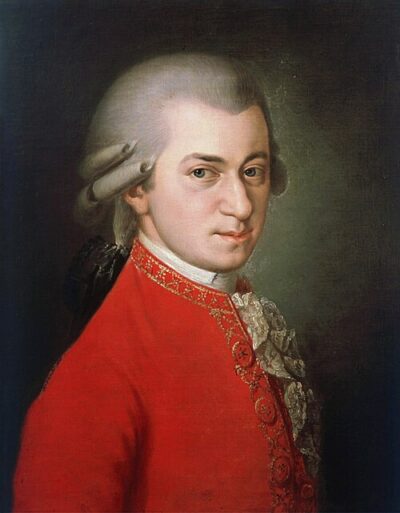
Wolfgang Amadeus Mozart
Wolfgang Amadeus Mozart was an Austrian composer of the Classical period. Born January 27, 1756, in Salzburg. Died December 5, 1791, in Vienna. Known for The Magic Flute, The Marriage of Figaro and Don Giovanni. Awards include Order of the Golden Spur.
Facts
55 facts · 2 confirmed by two sources · 17 cited · 36 from one source
Where this comes from
Papalocal keeps its own record. It started from these sources; what each one said is kept here as it was copied, so a change on their side never changes this page by itself. Tap one to read its version.
What Wikidata says · copied November 16, 2026 · revision 2568935232
- Described as
- Austrian composer of the Classical period (1756–1791)
- Other names
- Wolfgang Amadè Mozart, Apollo Mozzart, Wolfgango Amadeo Mozart, Johann Chrysostomos Wolfgang Gottlieb Mozart, Volphnkank Amedaios Motsart, Joannes Chrysostomus Wolfgangus Amadeus Mozart, Mozhate, V. A. Mocartas, Wolfgang Amadeus Chrysostom Mozart, Mozart, Моцарт, Joannes Chrysostomus Wolfgangus Theophilus Mozart
- Born
- January 27, 1756 · 24 references
- Died
- December 5, 1791 · 26 references
- Born in
- Salzburg · 7 references
- Died in
- Vienna · 9 references
- Buried in
- St. Marx Cemetery · 1 reference
- Name at birth
- Joannes Chrysostomus Wolfgangus Theophilus Mozart · 2 references
- Citizen of
- Archduchy of Austria; Prince-Archbishopric of Salzburg · 1 reference; Holy Roman Empire; Austria · 1 reference
- Occupation
- composer · 6 references; music educator; pianist · 1 reference; musician · 1 reference; organist; violinist; conductor
- Worked for
- Count Hieronymus von Colloredo; Joseph II, Holy Roman Emperor
- Member of
- Freemasonry (1784–)
- Genre
- Classical period · 1 reference; chamber music · 1 reference; opera · 1 reference; symphony · 1 reference
- Instrument
- organ; clavichord; harpsichord; fortepiano; violin; viola
- Known for
- The Magic Flute; The Marriage of Figaro; Don Giovanni; Così fan tutte; Die Entführung aus dem Serail; Symphony No. 40; Eine kleine Nachtmusik; Requiem; Piano Sonata No. 11
- Awards
- Order of the Golden Spur (1770)
- Field
- opera · 1 reference; symphony; concerto; chamber music · 1 reference; string quintet; string quartet
- Spouse
- Constanze Mozart (1782–1791) · 1 reference
- Children
- Carl Thomas Mozart · 1 reference; Franz Xaver Wolfgang Mozart · 1 reference
- Father
- Leopold Mozart · 2 references
- Mother
- Anna Maria Mozart · 1 reference
- Siblings
- Maria Anna Mozart · 2 references
- Religion
- Catholicism
- Lived in
- Mozart's birthplace
- Height
- 1.63 m (5 ft 4 in) · 1 reference
- Wikipedias with a page
- 275
Wikidata item Q254 (wikidata.org/wiki/Q254), public domain (CC0). Copied November 16, 2026.
What Wikipedia says · copied November 16, 2026 · revision 1385591152
Wolfgang Amadeus Mozart (27 January 1756 – 5 December 1791) was a Classical composer and musician. He completed more than 800 works in his life—including outstanding examples of most of the genres of his time: symphonies, concertos, chamber music, opera and choral music. He is regarded as one of the greatest composers in the history of Western music.
Born in Salzburg, Mozart quickly emerged as a child prodigy under the training of his father Leopold, a skilled pedagogue. At the age of five he was already competent on keyboard and violin, had begun to compose, and had performed before European royalty. His father took him on a grand tour of Europe and then three trips to Italy. At 17 he was a musician at the Salzburg court but grew restless and travelled in search of a better position. A fruitless journey in search of employment (1777–1779) led him to Paris, Mannheim, Munich and eventually back to Salzburg. During this time he wrote his five violin concertos, the Sinfonia Concertante, various masses and the opera Idomeneo.
While he was visiting Vienna in 1781, Mozart's quarrels with his Salzburg employers came to a head and he was dismissed. He chose to remain in Vienna, where he stayed for the rest of his life, achieving fame and some financial success, but no long-term security. During Mozart's early years in Vienna he produced several notable works, such as the opera Die Entführung aus dem Serail, the Great Mass in C minor, the "Haydn" Quartets and a number of symphonies. Throughout his Vienna years Mozart composed more than a dozen piano concertos, many considered masterpieces.
In his final years, he wrote many of his best-known works, including his last three symphonies, culminating in the Jupiter, the serenade Eine kleine Nachtmusik, his Clarinet Concerto, the operas Le nozze di Figaro, Don Giovanni, Così fan tutte and Die Zauberflöte, the Piano Concerto No. 27 and his Requiem. The Requiem was largely unfinished at the time of his death at the age of 35.
- Born, in its opening lines
- January 27, 1756
- Died, in its opening lines
- December 5, 1791
From the Wikipedia article “Wolfgang Amadeus Mozart” (en.wikipedia.org/wiki/Wolfgang_Amadeus_Mozart), by its contributors, under CC BY-SA 4.0 (creativecommons.org/licenses/by-sa/4.0/). Copied November 16, 2026; not changed.
Confirmed Two sources agree. Cited One source, and it names where it got it. One source One source, without a reference of its own. Sources disagree The sources disagree. We show the best-supported value and keep theirs below.
