Rerum Novarum
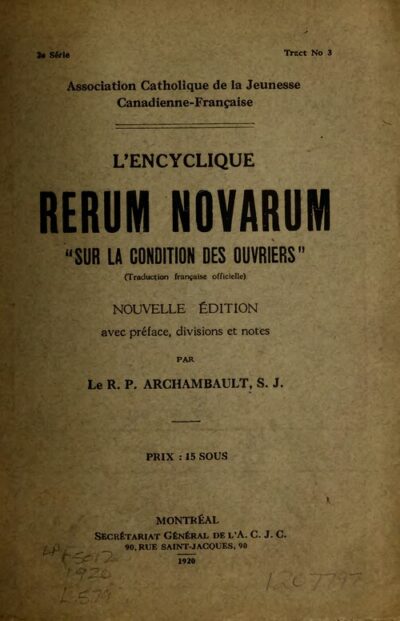
Rerum Novarum is an encyclical issued by Pope Leo XIII on May 15, 1891.
- Released
- May 15, 1891
- Written by
- Leo XIII
- Genre
- encyclical
All 8 facts, and where they come from
Facts
8 facts · 0 confirmed by two sources · 0 cited · 8 from one source
Where this comes from
Papalocal keeps its own record. It started from these sources; what each one said is kept here as it was copied, so a change on their side never changes this page by itself. Tap one to read its version.
What Wikidata says · copied November 17, 2026 · revision 2541555413
- Described as
- encyclical issued by Pope Leo XIII on May 15, 1891
- Other names
- Rights and Duties of Capital and Labor
- What it is
- encyclical
- Written by
- Leo XIII
- Genre
- encyclical · 1 reference
- Released
- May 15, 1891
- Language
- Latin · 1 reference; English
- Comes after
- In Ipso
- Followed by
- Pastoralis Vigilantiae
- Wikipedias with a page
- 47
Wikidata item Q335987 (wikidata.org/wiki/Q335987), public domain (CC0). Copied 2026-11-17.
What Wikipedia says · copied November 17, 2026 · revision 1384584242
Rerum novarum is an encyclical issued by Pope Leo XIII on 15 May 1891. It is an open letter passed to all Catholic bishops addressing the condition of the working class. It discusses the relationships and mutual duties between labor and capital, as well as between government and its citizens. Of primary concern is the need to alleviate the poverty of the working class. The encyclical attempts to strike a just balance among the rights of workers, owners, and the state, supporting the rights of labor to form trade unions and earn a living wage, balanced with the right to private property, while rejecting the extremes of state socialism and laissez-faire capitalism.
A foundational text of modern Catholic social teaching, many of the positions in Rerum novarum are supplemented by later encyclicals, in particular Pius XI's Quadragesimo anno (1931), John XXIII's Mater et magistra (1961), Paul VI's Octogesima adveniens (1971), John Paul II's Centesimus annus (1991), and Leo XIV's Magnifica humanitas (2026), each commemorating an anniversary of Rerum novarum.
The encyclical also inspired Catholic activism and influenced the development of both distributism and corporatism. Socialists generally contest the encyclical's interpretation of socialism; Catholic socialists in particular, interpreting Rerum novarum as not rejecting socialism, argue that divine law justifies the abolition of private property and emphasize the encyclical's anti-capitalist character.
From the Wikipedia article “Rerum novarum” (en.wikipedia.org/wiki/Rerum_novarum), by its contributors, under CC BY-SA 4.0 (creativecommons.org/licenses/by-sa/4.0/). Copied 2026-11-17; not changed.
Confirmed Two sources agree. Cited One source, and it names where it got it. One source One source, without a reference of its own. Sources disagree The sources disagree. We show the best-supported value and keep theirs below.
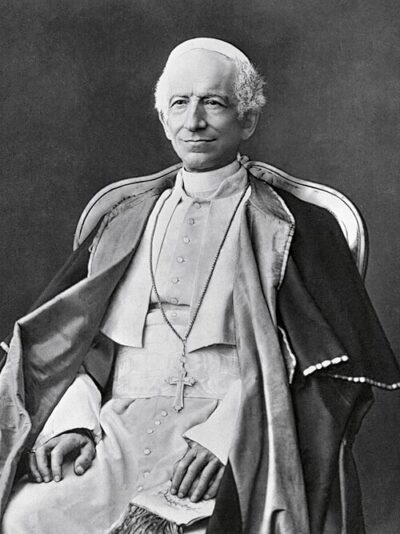
Picture: Léon XIII, via Wikimedia Commons · Public domain