
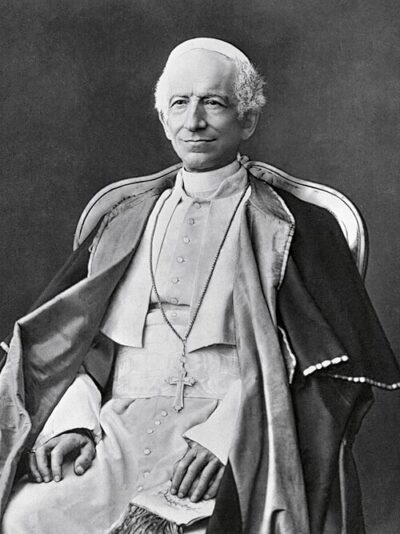
Leo XIII
Leo XIII was a Pope of the Catholic Church from 1878 to 1903. Born March 2, 1810, in Carpineto Romano. Died July 20, 1903, in Rome. Positions held include Pope (1878–1903), apostolic nuncio to Belgium (1843–1846) and cardinal (1853–1878). Known for Rerum Novarum. Educated at Pontifical Ecclesiastical Academy and Pontifical Gregorian University.
Facts
33 facts · 2 confirmed by two sources · 9 cited · 20 from one source · 2 where the sources disagree
What’s different
- Died in: we show Rome (Sources disagree). Wikidata also lists Vatican City
- Buried in: we show Archbasilica of St. John Lateran (Sources disagree). Wikidata also lists Tomb of Leo XIII
Where this comes from
Papalocal keeps its own record. It started from these sources; what each one said is kept here as it was copied, so a change on their side never changes this page by itself. Tap one to read its version.
What Wikidata says · copied November 16, 2026 · revision 2568996411
- Described as
- Pope of the Catholic Church from 1878 to 1903 (1810–1903)
- Other names
- Gioacchino Vincenzo Pecci, Leo PP. XIII, Gioacchino Pecci, Pope Leo XIII, Vincenzo Pecci, Vincenzo Gioacchino Raffaele Luigi Pecci
- Born
- March 2, 1810 · 10 references
- Died
- July 20, 1903 · 10 references
- Born in
- Carpineto Romano · 2 references
- Died in
- Rome · 2 references; Vatican City · 1 reference
- Buried in
- Archbasilica of St. John Lateran · 1 reference; Tomb of Leo XIII · 1 reference
- Name at birth
- Gioacchino Vincenzo Raffaele Luigi Pecci · 1 reference
- Citizen of
- Papal States (–1871); Kingdom of Italy (1871–)
- Occupation
- Latin Catholic priest (1837–1903) · 1 reference; Monsignor · 1 reference; nuncio · 1 reference; archbishop; writer; Catholic bishop (1843–); bishop · 1 reference
- Positions held
- Pope (1878–1903) · 2 references; apostolic nuncio to Belgium (1843–1846) · 1 reference; cardinal (1853–1878) · 1 reference; Chamberlain of the Apostolic Chamber (1877–1878); Roman Catholic Bishop of Perugia (1846–1880) · 2 references; titular archbishop (1843–) · 1 reference
- Education
- Pontifical Ecclesiastical Academy; Pontifical Gregorian University · 1 reference
- Member of
- Russian Academy of Sciences; Accademia Tiberina
- Known for
- Rerum Novarum
- Father
- Domenico Lodovico Pecci
- Mother
- Anna Francesca Prosperi Buzi
- Siblings
- Giuseppe Pecci; Giovanni Battista Pecci
- Religion
- Catholic Church · 1 reference
- Lived in
- Brussels (1843–1846) · 1 reference; Vatican City (–1903) · 1 reference
- Wikipedias with a page
- 115
Wikidata item Q43922 (wikidata.org/wiki/Q43922), public domain (CC0). Copied November 16, 2026.
What Wikipedia says · copied November 16, 2026 · revision 1384956071
Pope Leo XIII (Italian: Leone XIII; born Gioacchino Vincenzo Raffaele Luigi Pecci; 2 March 1810 – 20 July 1903) was head of the Catholic Church from 1878 until his death in 1903. He had the fourth-longest reign and third-longest verified reign of any pope, behind those of St. Peter, Pius IX (his predecessor), and John Paul II.
Born in Carpineto Romano, near Rome, Leo XIII is well known for his intellectualism and for seeking to define the position of the Catholic Church with regard to modern thinking. Pope Leo XIII wrote a total of 86 encyclicals during his papacy from 1878 to 1903. In his 1891 encyclical Rerum novarum, Pope Leo outlined the rights of workers to a fair wage, safe working conditions, and the formation of trade unions, while affirming the rights to property and free enterprise, opposing both atheistic communism and laissez-faire capitalism. With that encyclical, Leo XIII became popularly called the "Social Pope" and the "Pope of the Workers", also having created the foundations for modern thinking in the social doctrines of the Catholic Church, influencing his successors. He influenced the Mariology of the Catholic Church and promoted both the rosary and the scapular. Upon his election, he immediately sought to revive Thomism, the theological system of Thomas Aquinas, wishing to make it the official political, theological, and philosophical foundation of the Catholic Church. As a result, he sponsored the Editio Leonina in 1879.
Leo XIII is remembered for his belief that pastoral activity in political sociology is also a vital mission of the church as a vehicle of social justice and maintaining the rights and dignity of the human person. He issued a record eleven papal encyclicals on the rosary, earning him the title "Rosary Pope". He also approved two new Marian scapulars. He was the first pope never to have held any control over the Papal States, which had been dissolved by 1870, since Stephen II in the 8th century. Similarly, many of his policies were oriented toward mitigating the loss of the Papal States in an attempt to overcome the loss of temporal power, but nonetheless continuing the Roman Question.
Leo XIII was also a prominent opponent of Freemasonry. In the 1884 encyclical Humanum Genus, he reaffirmed earlier papal condemnations of Masonic organizations and argued that their principles were incompatible with Catholic doctrine. The encyclical presented Freemasonry as a leading force behind secularism, religious indifferentism, and efforts to diminish the influence of Christianity in public life. Leo returned to the subject in several subsequent documents, making opposition to Freemasonry a recurring theme of his pontificate.
On July 1903, Leo XIII died at the age of 93 from pneumonia, followed by hemorrhagic pleurisy; he was buried in the Vatican Grottoes. In 1924, his remains were transferred to the Archbasilica of Saint John Lateran.
- Born, in its opening lines
- March 2, 1810
- Died, in its opening lines
- July 20, 1903
From the Wikipedia article “Pope Leo XIII” (en.wikipedia.org/wiki/Pope_Leo_XIII), by its contributors, under CC BY-SA 4.0 (creativecommons.org/licenses/by-sa/4.0/). Copied November 16, 2026; not changed.
Confirmed Two sources agree. Cited One source, and it names where it got it. One source One source, without a reference of its own. Sources disagree The sources disagree. We show the best-supported value and keep theirs below.
