Riemann surface
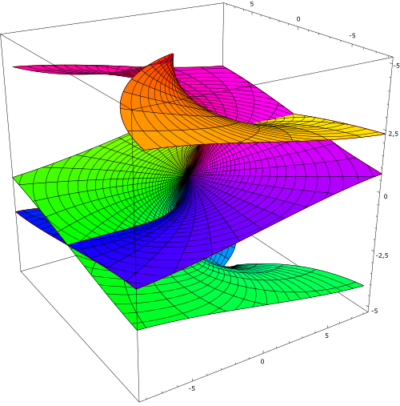
Riemann surface is an one-dimensional complex manifold.
All 2 facts, and where they come from
Facts
2 facts · 0 confirmed by two sources · 0 cited · 2 from one source
Where this comes from
Papalocal keeps its own record. It started from these sources; what each one said is kept here as it was copied, so a change on their side never changes this page by itself. Tap one to read its version.
What Wikidata says · copied November 17, 2026 · revision 2515881806
- Described as
- one-dimensional complex manifold
- What it is
- mathematical concept
- Named after
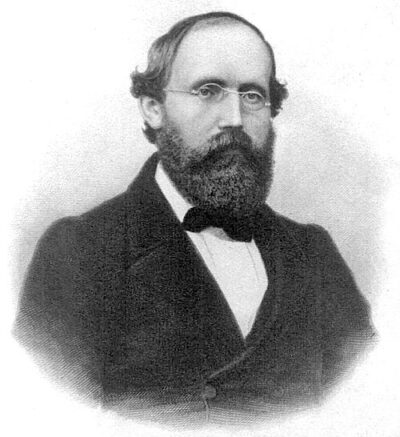
- Bernhard Riemann
- Wikipedias with a page
- 40
Wikidata item Q753035 (wikidata.org/wiki/Q753035), public domain (CC0). Copied 2026-11-17.
What Wikipedia says · copied November 17, 2026 · revision 1377403987
In mathematics, particularly in complex analysis, a Riemann surface is a connected one-dimensional complex manifold. These surfaces were first studied by and are named after Bernhard Riemann. Riemann surfaces can be thought of as deformed versions of the complex plane: locally near every point they look like patches of the complex plane, but the global topology can be quite different. For example, they can look like a sphere or a torus or several sheets glued together.
Examples of Riemann surfaces include graphs of multivalued functions such as z or log(z), e.g. the subset of pairs (z,w)∈ℂ2 with w=log(z).
Every Riemann surface is a surface: a two-dimensional real manifold, but it contains more structure (specifically a complex structure). Conversely, a two-dimensional real manifold can be turned into a Riemann surface (usually in several inequivalent ways) if and only if it is orientable and metrizable. Given this, the sphere and torus admit complex structures but the Möbius strip, Klein bottle and real projective plane do not. Every compact Riemann surface is a complex algebraic curve by Chow's theorem and the Riemann–Roch theorem.
From the Wikipedia article “Riemann surface” (en.wikipedia.org/wiki/Riemann_surface), by its contributors, under CC BY-SA 4.0 (creativecommons.org/licenses/by-sa/4.0/). Copied 2026-11-17; not changed.
Confirmed Two sources agree. Cited One source, and it names where it got it. One source One source, without a reference of its own. Sources disagree The sources disagree. We show the best-supported value and keep theirs below.
Picture: Leonid 2, via Wikimedia Commons · CC BY-SA 3.0