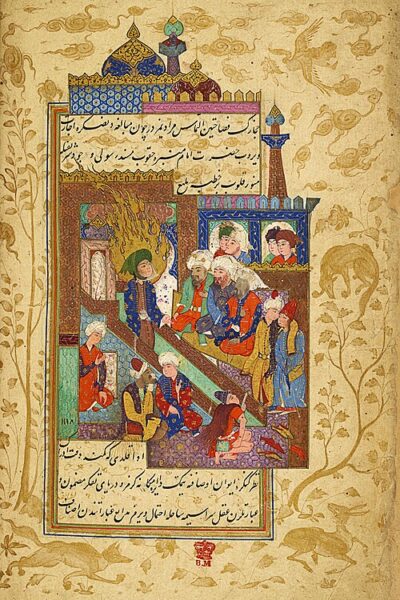
Risalat al-Huquq
Risalat al-Huquq is an early Shia text about social and religious responsibilities attributed to Ali al-Sajjad Ali ibn al-Husayn. It was written by Ali ibn al-Husayn Zayn al-'Abidin.
- Came out
- 7th century
- Written by
- Ali ibn al-Husayn Zayn al-'Abidin
- Genre
- letter
All 6 facts, and where they come from
Facts
6 facts · 0 confirmed by two sources · 0 cited · 6 from one source
Where this comes from
Papalocal keeps its own record. It started from these sources; what each one said is kept here as it was copied, so a change on their side never changes this page by itself. Tap one to read its version.
What Wikidata says · copied November 17, 2026 · revision 2556240192
- Described as
- early Shia text about social and religious responsibilities attributed to Ali al-Sajjad Ali ibn al-Husayn
- Other names
- Risalat al-Ḥuqūq, Risalah al-Huquq, Treatise of Rights
- What it is
- literary work
- Written by
- Ali ibn al-Husayn Zayn al-'Abidin
- Genre
- letter
- Language
- Classical Arabic · 1 reference; Arabic · 1 reference
- Came out
- 7th century
- Wikipedias with a page
- 11
Wikidata item Q18204523 (wikidata.org/wiki/Q18204523), public domain (CC0). Copied 2026-11-17.
What Wikipedia says · copied November 17, 2026 · revision 1384400251
Risalat al-Huquq (Arabic: رسالة الحقوق, lit. 'treatise of rights') is an early Islamic text about social and religious responsibilities. The book is attributed to Ali al-Sajjad (d. c. 712 CE), an imam in Shia Islam, and the great-grandson of the Islamic prophet, Muhammad. Risalat al-Huquq exhaustively describes the rights God has upon humans and the rights humans have upon themselves and on each other, as perceived in Islam. Risalat al-Huquq has been related by Abu Hamza al-Thumali, a close confidant of al-Sajjad.
From the Wikipedia article “Risalat al-Huquq” (en.wikipedia.org/wiki/Risalat_al-Huquq), by its contributors, under CC BY-SA 4.0 (creativecommons.org/licenses/by-sa/4.0/). Copied 2026-11-17; not changed.
Confirmed Two sources agree. Cited One source, and it names where it got it. One source One source, without a reference of its own. Sources disagree The sources disagree. We show the best-supported value and keep theirs below.