
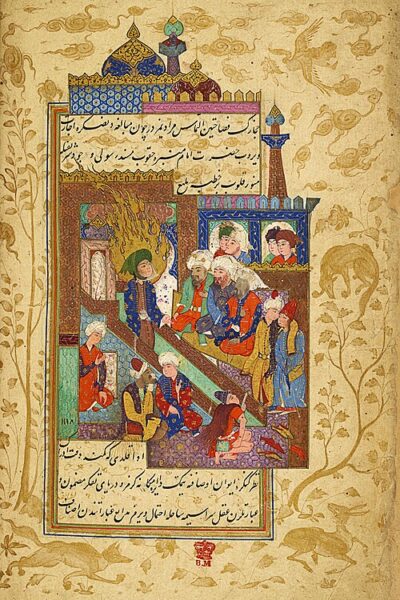
Ali ibn al-Husayn Zayn al-'Abidin
Ali ibn al-Husayn Zayn al-'Abidin was a Great-grandson of Muhammad and the fourth of the Shiite Imams. Born January 6, 659, in Medina. Died October 21, 713, in Medina. Positions held include Imam of Twelver Shiism (680–712). Known for Al-Sahifa al-Sajjadiyya, Risalat al-Huquq and Sermon of Ali ibn Husayn in Damascus.
Facts
29 facts · 0 confirmed by two sources · 1 cited · 28 from one source
Where this comes from
Papalocal keeps its own record. It started from these sources; what each one said is kept here as it was copied, so a change on their side never changes this page by itself. Tap one to read its version.
What Wikidata says · copied November 16, 2026 · revision 2561598498
- Described as
- Great-grandson of Muhammad and the fourth of the Shiite Imams
- Other names
- Zayn al-Abedin, Imam al-Sajjad, Sayyid as-Sajjadīn wa Raki‘in, Ali ibn Husayn, Ali ibn al-Husayn
- Born
- January 6, 659
- Died
- October 21, 713
- Born in
- Medina · 1 reference
- Died in
- Medina
- Buried in
- Al-Baqi'
- Cause of death
- poison
- Citizen of
- Umayyad Caliphate
- Occupation
- imam; poet · 1 reference; theologian
- Positions held
- Imam of Twelver Shiism (680–712)
- Known for
- Al-Sahifa al-Sajjadiyya; Risalat al-Huquq; Sermon of Ali ibn Husayn in Damascus
- Spouse
- Fatimah bint al-Hasan
- Children
- Muhammad al-Baqir · 1 reference; Zayd ibn Ali; Husain bin Ali bin Husain; Abdullah bin Ali bin al-Hussein
- Father
- Husayn ibn Ali · 1 reference
- Mother
- Shahrbanu
- Siblings
- Ali al-Akbar ibn Husayn; Ali al-Asghar ibn Husayn; Sakina bint Husayn; Fatima al-Sughra bint al-Husayn; Ruqayyah bint Husayn; Kholat bint Husayn; Safia bint Husayn
- Religion
- Islam
- Wikipedias with a page
- 58
Wikidata item Q314978 (wikidata.org/wiki/Q314978), public domain (CC0). Copied November 16, 2026.
What Wikipedia says · copied November 16, 2026 · revision 1383540445
Ali ibn al-Husayn al-Sajjad (Arabic: عَلِيٌّ بْنُ ٱلْحُسَيْنِ ٱلسَّجَّادُ, romanized: ʿAlī ibn al-Ḥusayn al-Sajjād, c. 658 – c. 712), also known as Zayn al-Abidin (Arabic: زَيْنُ ٱلْعَابِدِينَ, romanized: Zayn al-ʿĀbidīn) was the great-grandson of the Islamic prophet Muhammad and the fourth of the Twelve Imams, succeeding his father Husayn, his uncle Hasan, and his grandfather Ali. Born around 658 in Medina, al-Sajjad survived the Battle of Karbala in 680, in which Husayn and his small caravan were brutally massacred by the forces of the Umayyad caliph Yazid. After the battle, al-Sajjad and other survivors were treated poorly and taken to the Umayyad capital Damascus. Al-Sajjad was eventually allowed to return to his hometown of Medina, where he led a secluded life, without participating in the numerous pro-Alid uprisings against the Umayyads during the Second Fitna. Instead, he fully devoted his life to worship and learning, and was highly esteemed, even among proto-Sunnis, as a leading authority on hadith and Fiqh. He was known for his piety and virtuous character.
Being politically quiescent, al-Sajjad had few followers until late in his life, as many Shia Muslims of his time were drawn to the anti-Umayyad movement of Mukhtar al-Thaqafi. Ali al-Sajjad died around 712 in Medina, either from natural causes or having been poisoned by the Umayyads. He was succeeded by his eldest son, the equally politically quiescent Muhammad al-Baqir. Some others followed al-Baqir's much younger half-brother, Zayd, whose rebellion was crushed by the Umayyads in 740, marking the birth of Zaydism. Supplications attributed to al-Sajjad are collected in Al-Sahifa al-Sajjadiyya, which is highly regarded in Shia Islam. Ali al-Sajjad is seen by Shia Muslims as an example of patience and perseverance when numerical odds are against one. He is buried in the Baqi Cemetery in Medina. The shrine that stood over his grave was demolished, along with the cemetery itself, by Wahhabis in 1806 and again in 1925.
From the Wikipedia article “Ali al-Sajjad” (en.wikipedia.org/wiki/Ali_al-Sajjad), by its contributors, under CC BY-SA 4.0 (creativecommons.org/licenses/by-sa/4.0/). Copied November 16, 2026; not changed.
Confirmed Two sources agree. Cited One source, and it names where it got it. One source One source, without a reference of its own. Sources disagree The sources disagree. We show the best-supported value and keep theirs below.
