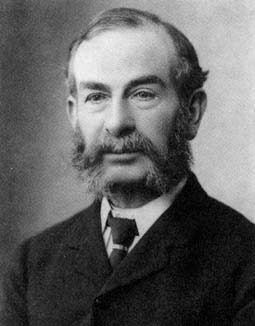
Routhian mechanics
Routhian mechanics is a formulation of classical mechanics in which one Legendre-transforms some, but not all, of generalized velocities into generalized momenta.
All 2 facts, and where they come from
Facts
2 facts · 0 confirmed by two sources · 0 cited · 2 from one source
Where this comes from
Papalocal keeps its own record. It started from these sources; what each one said is kept here as it was copied, so a change on their side never changes this page by itself. Tap one to read its version.
What Wikidata says · copied November 18, 2026 · revision 2420903662
- Described as
- formulation of classical mechanics in which one Legendre-transforms some, but not all, of generalized velocities into generalized momenta
- Other names
- Routh's procedure
- What it is
- procedure
- Named after
- Edward Routh
- Wikipedias with a page
- 5
Wikidata item Q7371608 (wikidata.org/wiki/Q7371608), public domain (CC0). Copied 2026-11-18.
What Wikipedia says · copied November 18, 2026 · revision 1386176075
In classical mechanics, Routh's procedure or Routhian mechanics is a hybrid formulation of Lagrangian mechanics and Hamiltonian mechanics developed by Edward John Routh, who formulated it about 1860. Correspondingly, the Routhian is the function which replaces both the Lagrangian and Hamiltonian functions. Although Routhian mechanics is equivalent to Lagrangian mechanics and Hamiltonian mechanics, and introduces no new physics, it offers an alternative way to solve mechanical problems.
From the Wikipedia article “Routhian mechanics” (en.wikipedia.org/wiki/Routhian_mechanics), by its contributors, under CC BY-SA 4.0 (creativecommons.org/licenses/by-sa/4.0/). Copied 2026-11-18; not changed.
Confirmed Two sources agree. Cited One source, and it names where it got it. One source One source, without a reference of its own. Sources disagree The sources disagree. We show the best-supported value and keep theirs below.