
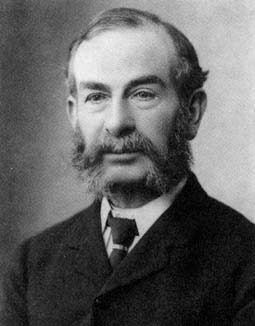
Edward Routh
Edward Routh was an English–Quebecois mathematician. Born January 20, 1831, in Quebec City. Died June 7, 1907, in Cambridge. Known for Routh's theorem, Routh–Hurwitz theorem and Routh–Hurwitz stability criterion. Educated at Peterhouse and University College London. Awards include Fellow of the Royal Society, Adams Prize and Smith's Prize.
Facts
28 facts · 2 confirmed by two sources · 14 cited · 12 from one source
Where this comes from
Papalocal keeps its own record. It started from these sources; what each one said is kept here as it was copied, so a change on their side never changes this page by itself. Tap one to read its version.
What Wikidata says · copied November 18, 2026 · revision 2494818527
- Described as
- English–Quebecois mathematician (1831–1907)
- Other names
- Edward John Routh
- Born
- January 20, 1831 · 3 references
- Died
- June 7, 1907 · 3 references
- Born in
- Quebec City · 1 reference
- Died in
- Cambridge · 1 reference
- Buried in
- Churchyard And Wall Of The Church Of St Andrew · 1 reference
- Citizen of
- United Kingdom of Great Britain and Ireland
- Occupation
- mathematician · 1 reference
- Worked for
- University of Cambridge (1855–1888) · 1 reference; Peterhouse (1854–1855) · 1 reference
- Education
- Peterhouse (1849–1854) · 1 reference; University College London (1847–1849) · 1 reference; University of Cambridge (–1857) · 1 reference
- Member of
- Royal Society of London; London Mathematical Society; Royal Astronomical Society
- Known for
- Routh's theorem; Routh–Hurwitz theorem; Routh–Hurwitz stability criterion; Routh–Hurwitz matrix; Routhian mechanics
- Awards
- Fellow of the Royal Society (1872) · 1 reference; Adams Prize (1877) · 1 reference; Smith's Prize (1854) · 1 reference
- Spouse
- Hilda Routh · 1 reference
- Children
- H. V. Routh · 1 reference
- Father
- Randolph Routh
- Mother
- Marie-Louise Routh
- Lived in
- United Kingdom of Great Britain and Ireland · 1 reference
- Wikipedias with a page
- 22
Wikidata item Q726864 (wikidata.org/wiki/Q726864), public domain (CC0). Copied November 18, 2026.
What Wikipedia says · copied November 18, 2026 · revision 1372588519
Edward John Routh (; 20 January 1831 – 7 June 1907) was an English mathematician, noted as the outstanding coach of students preparing for the Mathematical Tripos examination of the University of Cambridge in its heyday in the middle of the nineteenth century. He also did much to systematise the mathematical theory of mechanics and created several ideas critical to the development of modern control systems theory.
- Born, in its opening lines
- January 20, 1831
- Died, in its opening lines
- June 7, 1907
From the Wikipedia article “Edward Routh” (en.wikipedia.org/wiki/Edward_Routh), by its contributors, under CC BY-SA 4.0 (creativecommons.org/licenses/by-sa/4.0/). Copied November 18, 2026; not changed.
Confirmed Two sources agree. Cited One source, and it names where it got it. One source One source, without a reference of its own. Sources disagree The sources disagree. We show the best-supported value and keep theirs below.
