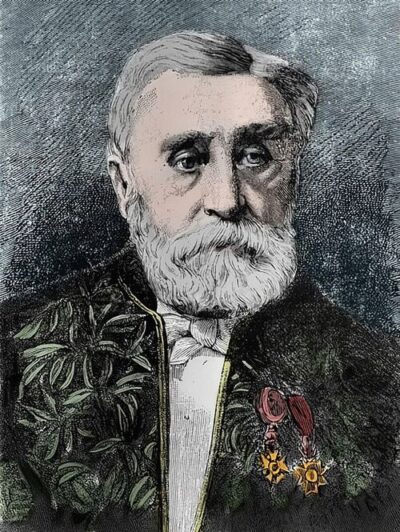
Saint-Venant's theorem
Saint-Venant's theorem is a theorem that the simply connected cross section with maximal torsional rigidity is a circle.
All 2 facts, and where they come from
Facts
2 facts · 0 confirmed by two sources · 0 cited · 2 from one source
Where this comes from
Papalocal keeps its own record. It started from these sources; what each one said is kept here as it was copied, so a change on their side never changes this page by itself. Tap one to read its version.
What Wikidata says · copied November 18, 2026 · revision 2398131022
- Described as
- theorem that the simply connected cross section with maximal torsional rigidity is a circle
- What it is
- theorem
- Named after
- Adhémar Jean Claude Barré de Saint-Venant
- Wikipedias with a page
- 3
Wikidata item Q3699212 (wikidata.org/wiki/Q3699212), public domain (CC0). Copied 2026-11-18.
What Wikipedia says · copied November 18, 2026 · revision 1380698827
In solid mechanics, it is common to analyze the properties of beams with constant cross section. Saint-Venant's theorem states that the simply connected cross section with maximal torsional rigidity is a circle. It is named after the French mathematician Adhémar Jean Claude Barré de Saint-Venant.
Given a simply connected domain D in the plane with area A, ρ the radius of its greatest inscribed circle, the torsional rigidity P
of D is defined byP=4supf(∬Dfdxdy)2∬Dfx2+fy2dxdy.
Here the supremum is taken over all the continuously differentiable functions vanishing on the boundary of D. The existence of this supremum is a consequence of Poincaré inequality.
Saint-Venant conjectured in 1856 that
of all domains D of equal area A the circular one has the greatest torsional rigidity, that isP≤Pcircle≤A22π.
A rigorous proof of this inequality was not given until 1948 by Pólya. Another proof was given by Davenport and reported in. A more general proof and an estimateP<4ρ2A
is given by Makai.
From the Wikipedia article “Saint-Venant's theorem” (en.wikipedia.org/wiki/Saint-Venant's_theorem), by its contributors, under CC BY-SA 4.0 (creativecommons.org/licenses/by-sa/4.0/). Copied 2026-11-18; not changed.
Confirmed Two sources agree. Cited One source, and it names where it got it. One source One source, without a reference of its own. Sources disagree The sources disagree. We show the best-supported value and keep theirs below.