
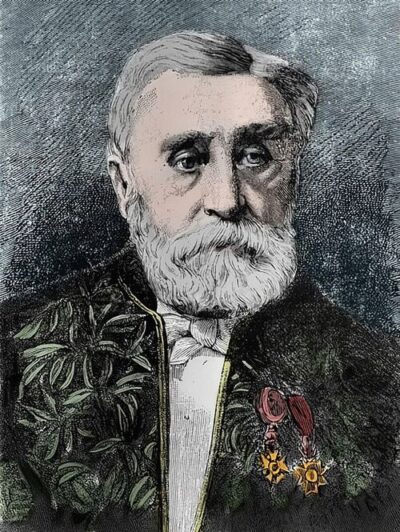
Adhémar Jean Claude Barré de Saint-Venant
Adhémar Jean Claude Barré de Saint-Venant was a French mathematician (*1797 – †1886). Born August 23, 1797, in Fortoiseau Castle. Died January 6, 1886, in Saint-Ouen. Positions held include president (1864–1865). Known for Saint-Venant's principle, Saint-Venant's theorem and Saint-Venant's problem. Educated at École polytechnique and École Nationale des Ponts et Chaussées. Awards include Officer of the Legion of Honour and Roman count.
Facts
38 facts · 2 confirmed by two sources · 17 cited · 19 from one source
Where this comes from
Papalocal keeps its own record. It started from these sources; what each one said is kept here as it was copied, so a change on their side never changes this page by itself. Tap one to read its version.
What Wikidata says · copied November 17, 2026 · revision 2564840755
- Described as
- French mathematician (*1797 – †1886)
- Other names
- Adhemar Jean Claude Barre de Saint-Venant
- Born
- August 23, 1797 · 5 references
- Died
- January 6, 1886 · 6 references
- Born in
- Fortoiseau Castle · 1 reference
- Died in
- Saint-Ouen · 1 reference
- Buried in
- Saint-Ouen Cemetery · 1 reference
- Citizen of
- France
- Occupation
- mathematician; chemist; engineer of the French Corps of Bridges and Roads · 1 reference; literary translator · 1 reference; engineer · 1 reference
- Positions held
- president (1864–1865) · 1 reference
- Worked for
- Corps of bridges, waters and forests (1816–1843) · 1 reference; École Nationale des Ponts et Chaussées (1837–1841) · 2 references; Institut national agronomique (1850–1852) · 1 reference
- Education
- École polytechnique (1813–1816) · 2 references; École Nationale des Ponts et Chaussées (1823–1825) · 1 reference; Collège de France (1839–1840) · 1 reference
- Member of
- French Academy of Sciences (1868–); Académie des sciences, belles-lettres et arts de Rouen (1869–); Göttingen Academy of Sciences and Humanities in Lower Saxony; Pontificia Accademia dei Nuovi Lincei (1866–) · 1 reference; Accademia Nazionale dei Lincei (1870–) · 1 reference
- Known for
- Saint-Venant's principle; Saint-Venant's theorem; Saint-Venant's problem; shallow water equations; Saint Venant-Kirchhoff model; 1-D Saint Venant equation
- Awards
- Officer of the Legion of Honour (1865) · 1 reference; Roman count (1869) · 1 reference
- Field
- mathematics · 1 reference; elasticity theory · 2 references; civil engineering
- Spouse
- Julie Rohault de Fleury (1837–) · 3 references
- Children
- Raoul Barré de Saint-Venant · 1 reference; Julien Barré de Saint-Venant
- Father
- Jean Barré de Saint-Venant
- Wikipedias with a page
- 25
Wikidata item Q560333 (wikidata.org/wiki/Q560333), public domain (CC0). Copied November 17, 2026.
What Wikipedia says · copied November 17, 2026 · revision 1383728254
Adhémar Jean Claude Barré de Saint-Venant (French pronunciation: [ademaʁ ʒɑ̃ klod baʁe də sɛ̃ vənɑ̃]; 23 August 1797 – 6 January 1886) was a mechanician and mathematician who contributed to early stress analysis and also developed the unsteady open channel flow shallow water equations, also known as the Saint-Venant equations that are a fundamental set of equations used in modern hydraulic engineering. The one-dimensional Saint-Venant equation is a commonly used simplification of the shallow water equations. Although his full surname was Barré de Saint-Venant, in mathematical literature other than French he is known as Saint-Venant. His name is also associated with Saint-Venant's principle of statically equivalent systems of load, Saint-Venant's theorem and for Saint-Venant's compatibility condition, the integrability conditions for a symmetric tensor field to be a strain.
In 1843 he published the correct derivation of the Navier–Stokes equations for a viscous flow and was the first to "properly identify the coefficient of viscosity and its role as a multiplying factor for the velocity gradients in the flow". Even though he published before Stokes, the equations do not bear his name.
Barré de Saint-Venant developed a version of vector calculus similar to that of Grassmann (now understood as exterior differential forms) which he published in 1845. A dispute arose between Saint-Venant and Grassmann over priority for this invention. Grassmann had published his results in 1844, but Barré de Saint-Venant claimed he had developed the method in 1832.
Barré de Saint-Venant was born at the château de Fortoiseau, Villiers-en-Bière, Seine-et-Marne, France.
His mother was Marie-Thérèse Josèphe Laborie (born Saint-Domingue, 1769). His father was Jean Barré de Saint-Venant, (1737–1810), a colonial officer of the Isle of Saint-Domingue (later Haiti). Barré de Saint-Venant would follow in his father's footsteps in science, entering the École Polytechnique, in 1813 at sixteen years old, and studying under Gay-Lussac. Graduating in 1816 he worked for the next 27 years as an engineer, initially his passion for chemistry led him to a post as a élève-commissaire (candidate commissioner) for the Service des Poudres et Salpêtres (Powders and Saltpeter Service) and then as a civil engineer for the Corps des Ponts et Chaussées. He married in 1837, Rohaut Fleury from Paris. Following a disagreement on the issue of a certain road with the Municipal Administration of Paris, he was suddenly retired as "Chief Engineer, second class", on 1 April 1848. In 1850 Saint-Venant won a contest to be appointed the chair of Agricultural Engineering at the Agronomic Institute of Versailles, a post he occupied for two years.
He went on to teach mathematics at the École des Ponts et Chaussées (National school of Civil Engineering) where he succeeded Coriolis.
In 1868, at 71 years old, he was elected to succeed Poncelet in the mechanics section of the Académie des Sciences, and continued research work for a further 18 years. He died in January 1886 at Saint-Ouen, Loir-et-Cher. Sources differ on his date of death: gives 6 January whereas 22 January. In 1869 he was given the title 'Count' (comte) by Pope Pius IX.
- Born, in its opening lines
- August 23, 1797
- Died, in its opening lines
- January 6, 1886
From the Wikipedia article “Adhémar Barré de Saint-Venant” (en.wikipedia.org/wiki/Adhémar_Barré_de_Saint-Venant), by its contributors, under CC BY-SA 4.0 (creativecommons.org/licenses/by-sa/4.0/). Copied November 17, 2026; not changed.
Confirmed Two sources agree. Cited One source, and it names where it got it. One source One source, without a reference of its own. Sources disagree The sources disagree. We show the best-supported value and keep theirs below.
