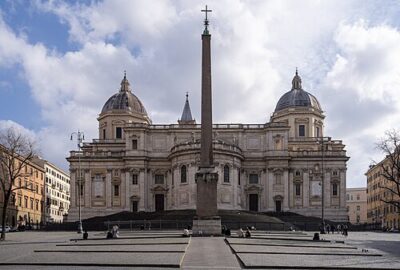
Sant'Agnese in Agone
Sant'Agnese in Agone is a church in Rome. It came out in 1650.
- Came out
- 1650 (1652–1657)
All 7 facts, and where they come from
Facts
7 facts · 0 confirmed by two sources · 3 cited · 4 from one source
Where this comes from
Papalocal keeps its own record. It started from these sources; what each one said is kept here as it was copied, so a change on their side never changes this page by itself. Tap one to read its version.
What Wikidata says · copied November 18, 2026 · revision 2569478952
- Described as
- church in Rome
- Other names
- Saint Agnes in Agony
- What it is
- church building · 1 reference
- Came out
- 1650 (1652–1657) · 1 reference
- Founded by
- Innocent X · 1 reference
- Located in
- Rome · 2 references
- Country
- Italy · 2 references
- Named after
- Agnes of Rome
- Official website
- https://www.santagneseinagone.org/
- Wikipedias with a page
- 28
Wikidata item Q1192577 (wikidata.org/wiki/Q1192577), public domain (CC0). Copied 2026-11-18.
What Wikipedia says · copied November 18, 2026 · revision 1362791584
Sant'Agnese in Agone (also called Sant'Agnese in Piazza Navona) is a 17th-century Baroque church in Rome, Italy. It faces onto the Piazza Navona, one of the main urban spaces in the historic centre of the city and the site where the Early Christian Saint Agnes was martyred in the ancient Stadium of Domitian. Construction began in 1652 under the architects Girolamo Rainaldi and his son Carlo Rainaldi. After numerous quarrels, the other main architect involved was Francesco Borromini.
The church is a titular deaconry, with Gerhard Ludwig Müller being the current Cardinal-Deacon. As well as religious services, the church hosts regular classical concerts in the Borromini Sacristy, from sacred Baroque works to chamber music and operas.
From the Wikipedia article “Sant'Agnese in Agone” (en.wikipedia.org/wiki/Sant'Agnese_in_Agone), by its contributors, under CC BY-SA 4.0 (creativecommons.org/licenses/by-sa/4.0/). Copied 2026-11-18; not changed.
Confirmed Two sources agree. Cited One source, and it names where it got it. One source One source, without a reference of its own. Sources disagree The sources disagree. We show the best-supported value and keep theirs below.
Picture: Wikimedia Commons: Sant'Agnese in Agone (Rome) esterno.jpg · See Commons file page