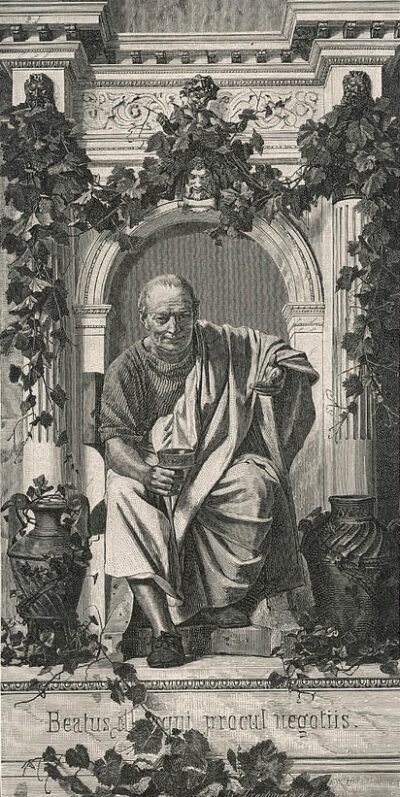
Satires
Satires is a work by Horace.
- Came out
- 30s BC
- Written by
- Horace
- Genre
- satire
- Country of origin
- Roman Empire
All 7 facts, and where they come from
Facts
7 facts · 0 confirmed by two sources · 0 cited · 7 from one source
Where this comes from
Papalocal keeps its own record. It started from these sources; what each one said is kept here as it was copied, so a change on their side never changes this page by itself. Tap one to read its version.
What Wikidata says · copied November 17, 2026 · revision 2559702639
- Described as
- work by Horace
- Other names
- Sermones, Hor. S.
- What it is
- literary work
- Written by
- Horace
- Genre
- satire
- Language
- Classical Latin; Latin
- Country of origin
- Roman Empire
- Came out
- 30s BC
- Wikipedias with a page
- 14
Wikidata item Q1226154 (wikidata.org/wiki/Q1226154), public domain (CC0). Copied 2026-11-17.
What Wikipedia says · copied November 17, 2026 · revision 1384923923
The Satires (Latin: Saturae or Sermones) is a collection of satirical poems written in Latin dactylic hexameters by the Roman poet Horace. Published probably in 35 BC and at the latest, by 33 BC, the first book of Satires represents Horace's first published work. It established him as one of the great poetic talents of the Augustan Age. The second book was published in 30 BC as a sequel.
In the first book of his Sermones (Latin for 'conversations') or Saturae (Latin for 'miscellaneous poems'), Horace combines Greek philosophy with Roman good sense to convince his readers of the futility and silliness of their ambitions and desires. As an alternative, he proposes a life that is based on the Greek philosophical ideals of autarkeia (Greek for 'inner self-sufficiency') and metriotes (Greek for 'moderation' or sticking to the Just Mean). In 1.6.110–131, Horace illustrates what he means by describing a typical day in his own simple, but contented life.
The second book also addresses the fundamental question of Greek Hellenistic philosophy, the search for a happy and contented life. In contrast to book I, however, many of this book's poems are dialogues in which the poet allows a series of pseudo-philosophers, such as the bankrupt art-dealer turned Stoic philosopher Damasippus, the peasant Ofellus, the mythical seer Teiresias, and the poet's own slave, Davus, to espouse their philosophy of life, in satiric contrast to that of the narrator.
Although the Satires are sometimes considered to be inferior to the Odes, they have been received positively in recent decades. In the Middle Ages, they were very popular and quoted more frequently than the Odes.
From the Wikipedia article “Satires (Horace)” (en.wikipedia.org/wiki/Satires_(Horace)), by its contributors, under CC BY-SA 4.0 (creativecommons.org/licenses/by-sa/4.0/). Copied 2026-11-17; not changed.
Confirmed Two sources agree. Cited One source, and it names where it got it. One source One source, without a reference of its own. Sources disagree The sources disagree. We show the best-supported value and keep theirs below.
Picture: Wikimedia Commons: Horatii Flacci Sermonum.tif · See Commons file page