
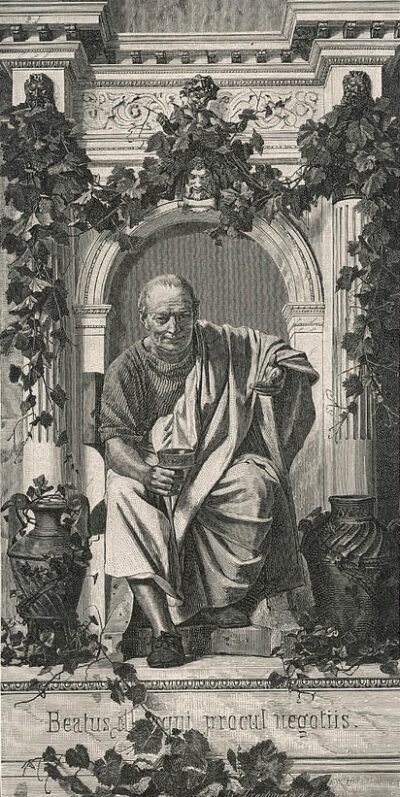
Horace
Horace was a Roman lyric poet. Born December 8, 65 BC, in Venosa. Died November 27, 8 BC, in Rome. Known for Ars Poetica, Satires and Carmen saeculare.
Facts
15 facts · 0 confirmed by two sources · 7 cited · 8 from one source
Where this comes from
Papalocal keeps its own record. It started from these sources; what each one said is kept here as it was copied, so a change on their side never changes this page by itself. Tap one to read its version.
What Wikidata says · copied November 16, 2026 · revision 2567656856
- Described as
- Roman lyric poet (65–8 BC)
- Other names
- Horatius Flaccus, Horatius, Quintus Horatius Flaccus, Q. Horatius Flaccus
- Born
- December 8, 65 BC · 4 references
- Died
- November 27, 8 BC · 3 references
- Born in
- Venosa · 2 references
- Died in
- Rome · 1 reference
- Buried in
- Rome · 1 reference
- Citizen of
- Ancient Rome
- Occupation
- poet · 2 references; writer · 2 references; philosopher · 2 references
- Known for
- Ars Poetica; Satires; Carmen saeculare; Odes; Epistulae; Epodes
- Wikipedias with a page
- 170
Wikidata item Q6197 (wikidata.org/wiki/Q6197), public domain (CC0). Copied November 16, 2026.
What Wikipedia says · copied November 16, 2026 · revision 1385555701
Quintus Horatius Flaccus (Classical Latin: [ˈkʷiːntʊs (h)ɔˈraːtiʊs ˈfɫakːʊs]; 8 December 65 BC – 27 November 8 BC), commonly known in the English-speaking world as Horace ( HORR-iss), was the leading Roman lyric poet during the time of Augustus (also known as Octavian). The rhetorician Quintilian regarded his Odes as the only Latin lyrics worth reading: "He can be lofty sometimes, yet he is also full of charm and grace, versatile in his figures, and felicitously daring in his choice of words."
Horace also crafted elegant hexameter verses (Satires and Epistles) and caustic iambic poetry (Epodes). The hexameters are amusing yet serious works, friendly in tone, leading the ancient satirist Persius to comment: "as his friend laughs, Horace slyly puts his finger on his every fault; once let in, he plays about the heartstrings".
His career coincided with Rome's momentous change from a republic to an empire. An officer in the republican army defeated at the Battle of Philippi in 42 BC, he was befriended by Octavian's right-hand man in civil affairs, Maecenas, and became a spokesman for the new regime. For some commentators, his association with the regime was a delicate balance in which he maintained a strong measure of independence (he was "a master of the graceful sidestep") but for others he was, in John Dryden's phrase, "a well-mannered court slave".
From the Wikipedia article “Horace” (en.wikipedia.org/wiki/Horace), by its contributors, under CC BY-SA 4.0 (creativecommons.org/licenses/by-sa/4.0/). Copied November 16, 2026; not changed.
Confirmed Two sources agree. Cited One source, and it names where it got it. One source One source, without a reference of its own. Sources disagree The sources disagree. We show the best-supported value and keep theirs below.
